Urban Wildland

REINTEGRATING HUMAN AND WILD CULTURES

  • Urban Wildland
  • Chaparral
  • About

On a Sunday Afternoon

August 30, 2015 by john davis

Very early this morning, Rita whooshes down Koenigstein in her red Tesla. Perhaps she is driving to the west side of Los Angeles to meet with a client. She is a personal trainer.

 Three years ago, she and her husband bought the old Hansen property (Death Comes to Koenigstein) at the top of the hill. A Los Angeles architect designed a modern re-model of the 1960’s stucco ranch house and after a protracted construction period approaching two years, Rita moved in earlier in the summer. The major views and windows are all to the west and despite a roof laden with photo-voltaic panels I imagine the house falls short of being net zero in energy consumption: of an afternoon, the searing westerly sun is likely to defeat the best efforts of even a continuously running refrigerated air cooling system, and then, when it cools down and the a/c finally shuts down, there’s the six or seven hours to charge the car’s battery at a 240 V outlet. As Kermit sings, “it’s not easy being green”.

Nevertheless, several of us on Koenigstein are attempting to present a virid face to the world. It is all, to some extent, a sham. The three overtly ‘green’ structures feature enough newly embedded energy to discount whatever savings to the grid are effected by their solar strategies. In the bigger picture, our contribution to saving the world is precisely nil. We remain part of a society that is dedicated to endless economic growth – of which so-called ‘green’ industry is a contributing factor.

It is the fatal model of expansionary capitalism (if that is not a tautology), consuming the world’s resources and producing biosphericaly threatening levels of greenhouse gases that requires immediate mitigation – not our relationship to the power grid. There is, of course, a connection between these two phenomena, but an amelioration of the latter is unlikely to make much of a dent in the former.  Indeed, it has been argued that the replacement of dirty, fossil energy with clean solar, hydro or nuclear power is entirely beside the point: what we need is a society that uses radically less energy, of whatever provenance, since its consumption is largely devoted, at present, to the rape of the world. 

The Pope, in his recent ‘green encyclical’ has called for a "truly communitarian economy", where "human beings in harmony with nature, structure the entire system of production and distribution in such a way that the abilities and needs of each individual find suitable expression in social life".  In other words, he is calling, at least in this speech, for the revolutionary overthrow of the results of at least half a millennium of Western colonialism in which the Papacy has been entirely complicit, as well as the financial structures that grew out of this exploitative model and that now support the plutocrats, oligarchs and kleptocrats who conspire to rule the world irrespective of the political arrangements that pertain in individual states.

But he goes further. He has nominated as the foot soldiers in his Revolutionary Army, "social poets" who remake "social reality" along their own unique paths, person by person, generation by generation. It is a fantastically bold vision that entirely transcends ideology and attempts to return the world to a prelapsarian Eden where individuals can create their own destinies certain of "access to education, health care, new technologies, artistic and cultural manifestations, communications and recreation". Nothing here then, that cannot be achieved in the kind of primal harmony evinced by tribal societies intimately connected to their local ecosystems and surviving within them by hunting and gathering - in a return, in other words, to traditions from which Homo sapiens has only very recently departed. The Pope may believe that his Edenic vision can be achieved without abandoning the technological infrastructure of the modern world, but that infrastructure is entirely dependent on the exploitative model he deplores. The Pope, as Unintended Revolutionary is, perhaps, not quite ready to follow the full implications of his utopian, populist rhetoric.

Neither are we, emerald hued ones, on Koenigstein Road. Our position, as beacons of energy responsibility, does not quite elevate us to the position of social poets. We are acting in the belief that the same kind of thinking that got us into this mess can be utilized in extricating ourselves from it - that ever more sophisticated, nature alienating technologies can save us from the previous generation of sophisticated, nature alienating technologies; that embedded energy is somehow free provided we use it to demonstrate our conservation bona fides; that conspicuous, individual consumption can be justified if it models a slightly better than average understanding of how to build responsibly in the urbanwildland.

Not a social poet then, but at my best, perhaps, a lyrical observer of the rural scene: a watcher of the weather, a cataloger of the light, of the twilight and of the dark and, betwixt all this, a writer of jeremiads, a doomsayer, an unrepentant nostalgist and occasionally, a bringer of hope - my bleak outlook flecked with gold seams of optimism, like July's drenching rain in an unending season of drought.

As the veil of rain lifted a world of yellow green was revealed, punctuated with late blue-grey evening shadows; the two galvanized corrugated steel water tanks at the base of the hill pulsated with a silvery, aqueous light - their conical lids reflecting, in a colloidal amalgam, the concentrated light of the tropical skybowl. The infinitely subtle colors that surround our house reach through the windows (despite the impediment of their solar bronze coating) and inflect the pure white of the walls. Our house, as I was reminded when dining at a friend’s place at the tippy-top of Foothill, sits in the landscape, partakes of it and is colored by it. Our friend's, sits on the landscape, in sublime difference.

The unexpected July rain had me thinking: are we, in Hawaii yet? Or better yet, Japan.....where Rikyu grey might so perfectly describe the eventide chromatic impact of tropical depression Dolores on the parched chaparral of Upper Ojai? No: just another Global Warming impacted Ojai summer long since returned to normal: dry, bleached and hot - 106 degrees Fahrenheit this Sunday, 16th. August, an Ojai record high for the day. Now, at the end of the month, it is still warm, soft and the day capable, if one takes a moment to bask in it, of inducing a delirious drowsiness. Meanwhile, we thrill in anticipation of a major El Niño promised us by N.O.A.A., which, in conjunction with the hemispheric air pressure variable, the Southern Oscillation, (ENSO) is a reliable indicator of heavy winter and spring rain in California…….

Not then, a social poet enrolled in God’s Army (as proclaimed by Pope Francis), nor a Green Crusader, but simply the creator of a place (by virtue of building a structure and tending the land), and the creator of an ecotone, between town and country (manifested both physically and through the posts of Urbanwildland): a place where I can observe the confluence, at least within my own psyche, of drought and rain, of the wild and the urban and of hope and hopelessness. Alternatively,

We'll keep on spending sunny days this way
We're gonna talk and laugh our time away
I feel it coming closer day by day
Life would be ecstasy, you and me endlessly

Edward Brigarti and Felix Cavaliere (of The Rascals)

August 30, 2015 /john davis
Energy
1 Comment

Little Boy Lost

August 25, 2015 by john davis

In the time I have spent living off of Koenigstein, there have been three births, two deaths and now, a small boy found somewhere along the road. Sammy Evans was discovered at 7pm on Monday, after he was reported lost some six hours before, having last been seen on Tree Ranch Road.  He was located by a bloodhound named Roscoe and Michael Grossman of Ventura County K9 Search and Rescue. "He's a wonderful kid who got confused and got scared and they found him," his father Steve Evans said. "The gratitude we have is unbelievable."

 In the early evening, as the wind dropped, the search-dog picked up Sammy’s scent and led his handler up Koenigstein Road. The prescient mystic, William Blake, has most of the details right: 

 “Then they followed

Where the vision led,

And saw their sleeping child

Among tigers wild.

To this day they dwell

In a lonely dell,

Nor fear the wolvish howl

Nor the lion’s growl.”

Sammy was found, according to media reports, in a wooded area about a mile east of where he was last seen. No mention was made of finding mountain lions, coyotes or even foxes in the vicinity, although, on occasion, all three roam these parts. The media was mute too, on the exact nature of the woods in which he was found. I should add that young Sammy was apparently awake when discovered and spoke with his human rescuer. No word on his interaction with Roscoe, the bloodhound.

 I am an essayist not a journalist:  a quick check with local scribe Chris Wilson suggests that he is not following the story – he referred me to the Ojai Valley News’ intrepid Misty Volaski who after a cursory report in the local rag has moved on; fellow blogger and esteemed Ventura reporter, Kit Stolz, is missing in action, hiking the Pacific Crest trail somewhere along its more than twenty five hundred mile length; Urbanwildland is therefore attempting to pick up the threads in its author’s amateur, essay-ish kind of way.

 The story, as I have outlined it, is based on news reports. As a long-time historian manqué, however, I understand the value of original research. So it was that I drove the length of Tree Ranch Road hoping to detect some latent, psychic echoes of the parent’s panic on discovering the loss of their child or perhaps of Sammy’s desperation in attempting to flee the family unit. Note that I am discounting the notion that our boy wandered off unintentionally and became disoriented and lost. Ending up on Koenigstein involves traversing the County divide separating the Ventura and Santa Clara River watersheds, and requires a serious intent - a concerted effort to put distance between oneself and one’s nearest and dearest. Was there some inkling on Tree Ranch of what made Sammy run? (Ancient reference: What Makes Sammy Run, the 1960’s Broadway musical based on Bud Schulberg’s story of the rise and fall of Sammy Glick, archetypal Hollywood Jew – stereotyped as smart, ruthless, savvy and crude). Our Sammy is black, ten years old and four feet tall, but he too has demons that impel him to run.

Tree Ranch Road is mostly horse-properties. Not of the Kentucky blue grass, white fence, lush meadows kind, but the dry, dirt and dust, metal corral, hard-scrabble Ojai kind. It appears to be mostly a street of pick-up trucks and horse trailers casually parked in front of one story ranch houses; but as you drive north, across intermittent speed bumps, something changes. The 12700 block, where Sammy was reported missing, is composed of mostly two story structures of dubious architectural provenance and irrigated grounds that have aspirations (mostly unrealized) of achieving estate status. These gardens cling to some European ideal while their northern aspect is dominated by south facing native chaparral hills that rise up to Fuel Break Road, running along the near ridge, as it heads over to High Winds and Boccali’s Ranch. Lush exotics and schlerophytic natives are thus poised in a Mexican stand-off - nature and nurture unresolved and unresolvable.

 Sammy most likely stuck to the road, eschewing what for him were probably the unknown pleasures of bush-whacking over to Sisar, and then going cross-country to Koenigstein. Let’s face it: the kid was in escape mode, out Tree Ranch, east on the 150 then up Koenigstein - terra incognita – until he decided that a rest was in order and he hunkered down among the oaks on our property up the hill (favored hang-out, too, of recalcitrant Thomas Aquinas students, who chug beer and wine while enjoying the westerly views of the Upper Valley and the shade of our ancient live-oaks). I don’t mean to be proprietary, just saying that Lorrie and I are the chumps that pay the Ventura County property taxes on the only ‘wooded area’ directly off of Koenigstein. In other words, “Whose woods these are I think I know”.

 I am delighted to have played host, albeit unknowingly, to runaway Sammy. But it was the trees and their shade that appealed to him. It’s an old story: as William Bryant Logan points out in Oak – The Frame of Civilization, the genus is intimately involved in the recent development of humankind; as he says, “People stayed and went where the oaks were. There is some basic sympathy between oaks and humans.” Sammy was seeking comfort from Quercus agrifolia, the Coast Live Oak, the same tree that helped nurture ten thousand years of successive Native Californian cultures, finally ending with a constellation of balanocultures (oak and acorn societies) epitomized by the Chumash. As Logan notes, these were the last cultures on earth that continued to rely on the fruits of the oak where once they were a mainstay of the temperate belt that girdled the Northern Hemisphere after the end of the ice age.

 When he was nine, William Blake saw “a tree filled with angels, bright angelic wings bespangling every bough like stars”. In Martin Frederick’s, The Life of John Clare, 1865, he recounts that Clare had a favorite place where he would write his poetry. “it was the hollow of an old oak. Inside this old oak, John Clare used to sit in silent meditation for many hours together, unmindful even of the waning day and the mantle of darkness falling over the earth”.

How long did Sammy sit under the oak and what did he see? By the middle of August it is dark not long after eight. Was Sammy mindful of the waning day? What did he plan for the night? A few hundred yards to the south of his resting place are the trampled depressions (now mostly covered by chaparral) of the house sites for a small band of Chumash who lived on the banks of Bear Creek. Foxes begin to snarl as the light fades. Spirits of long dead Indians may still haunt the oak woodlands. Owls hoot and bats jink and fade as the sun drops into the westerly haze.

 Enter Roscoe: slobbering over the child and foreshortening the night of his young life. Safely back in the bosom of his family, under the now ever watchful eye of his parents our Little Boy Lost may yet be planning his next great escape. May Blake’s arboreal angels watch over him…..

August 25, 2015 /john davis
Chumash
Comment

Wild America

August 13, 2015 by john davis

Peering over time's fence, into the deeply shadowed back yard that is the twentieth century, where still linger the remnants of some fifty years of my phenomenological experience (some lived directly and some absorbed, in my youth from, for instance, a close reading of Arthur Mee's Children's Encyclopedia), I would venture that from a viridic (or ‘Green’) point of view, the two most significant events of that particular time (which, with good reason, is called the American century) were this country's establishment of the National Park system and the landing of a man on the moon.

Both events profoundly impact the way we understand our place in the world, particularly in this country (although the branding of Wild America is a global phenomenon) while, at the same time, both remain firmly rooted in the traditions of two millennia of anthropocentric imperialism predicated on our Christian, God-given dominion over the Planet. But the carving out of vast tracts of land in North America as partly manicured, but still plausible wilderness, and the perspective afforded by Armstrong's moon-walk are now key elements in a shift that is beginning to re-wire Humanity's relationship within the enveloping physical, biological and spiritual ecologies that support life on Earth.

Having gotten these two declarative paragraphs out of the way (but to the theme of which I will return) I turn now to the existential matter at hand. The condition of my Life. Right. Now.

I am entirely clad in polyester: perhaps for the very first time. I have long been a fabric snob - certainly since I was dressed as a child in sample clothes that my aunt liberated from Harrods' where she was the buyer for their children's department. Petit Bateau and Grenfell were my brands, although I longed for the more plebeian, provincial togs of my mates, sourced from dubious 'outfitters' in the nearby town or a barrow at the Saturday market. One particular item I craved, affected by the local nine year old toughs, was a spearmint green, rubberized wind-cheater with an elasticized waist and a jaunty flair of fabric over the hips, redolent of a sleeved doublet. I had to make do with a stinking poofter jacket made of the finely woven cotton cloth that had been standard equipment (as my father encouragingly told me) on the Everest expeditions of 1936, 1938 and 1952.

Now, in a strange turn of events, cotton is considered to be fatally conducive, if allowed to get wet, to hypothermia, and the prospective mountaineer, trekker or back-packer in the High Sierras is advised to don synthetic fabrics.  As a member of that third class of intrepid adventurers, I am done up in a plastic khaki shirt and grey, oil-derivative pants, branded as Mountain Hard Wear and manufactured in Vietnam - perhaps by child labor.

Driving from Ojai, up the 33, we three - friends Will, Victoria and I - journeyed over the magnificent Santa Ynez range and into the strange confluence of oil and agriculture, of carrots and crude, that supports Ventucopa and Cuyama. Then arrives Maricopa: a disappointed town awash in poverty porn and the grim nostalgia of failure squeezed between the Carrizo Plain and the huge Midway-Sunset oil field, where only a kitty litter factory on Golden Cat Road in the near-desert scrublands, offers any hope of local employment. Skirting oil-rich Taft, we motored on to the 99, heading into a vast pall of dust and diesel smoke that hung over the Central Valley, blotting out the Sierras beyond; across the 5, past egregiously exogenous fields of cotton and rice, onwards to Bakersfield, the storied destination of Dust Bowl migrants but now a boom town targeted by California’s incipient bullet train. Then, Visalia, gateway to Kings Canyon and Sequoia National Parks, beckoned.

After a night at the Atwell Mill campground we arrived next morning, kitted out in our polyester, at the Mineral King Ranger station - the National Forest Service guard-post at the wilderness frontier. Once cleared to proceed on our five day hike we began down the glacial valley and within twenty minutes, like some ambassador of the Wild Kingdom, there appeared a black bear squarely on the trail showing no inclination to move. Once assured, perhaps, that we fully acknowledged that we had entered its ursine world, the bear moved away, lumbering up the meadow.

Although both Sierran National Parks were founded in 1890, some eighteen years after Yellowstone, it was not until the establishment of the National Park Service, under Woodrow Wilson in 1916, that these repositories of wilderness began to assume their contemporary form. They had been founded, more or less, as pleasure grounds, a familiar nineteenth typology, but the new administrative structure was mandated "to conserve the scenery and the natural and historic objects and wildlife therein, and to provide for the enjoyment of the same in such manner and by such means as will leave them unimpaired for the enjoyment of future generations”.

Thus it was that the development of the picturesque qualities that had been the guiding aesthetic principal in the nineteenth century was replaced with notions of conservation – the explicit preservation of Wild America within borders patrolled by the quasi-military styled Park Service. Wilderness was henceforth to be sequestered in secure reservations and on full view, in perpetuity, to curious visitors from an increasingly urban and suburban America. The porosity of the frontier, where wilderness leaked into and around the infrastructure of civilization was banished in this organized attempt to corral the unruly (and usually economically marginal) and frame the scenic majesty of Wild America both as a backdrop to Imperial ambition and as a freely available instrument of commercial branding. Nevertheless, we three somehow believed we could transcend these socio-political realities and bask, for a while, in an unfettered natural world.

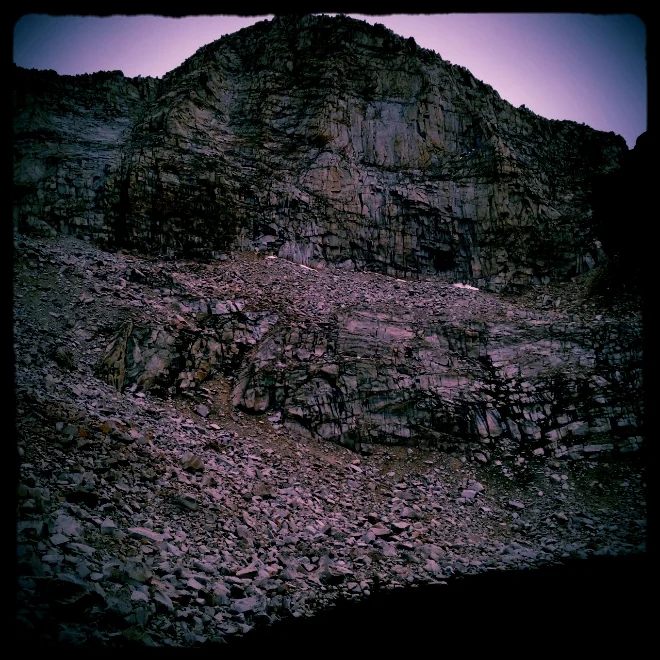
We walked over colls and passes, along creeks, through pine and redwood forests, across hanging valleys and the bleak geology above the tree line where glacial cirques supported lakes of unknowable depth. We swam in the late afternoons and at night, slept intermittently under bright stars and a waning gibbous moon.

Begun over fifty years ago, the mission to put a man on the moon was a product of American hubris, lingering national shame over the successful launching of the USSR's Sputnick, and the notion of extending the Imperial frontier into Space; it was enabled by an infrastructure established by the military industrial complex (initiated in WWII and expanded during the Cold War), rocket scientists looted from the ashes of the Third Reich, (personified by Wernher Von Braun who headed up the Atlas and Saturn rocket programs) and the inspiring, nationalist rhetoric of a young and supremely charismatic president.

The mission’s success had unexpected consequences: rather than heralding the dawn of America's Space Age (so long anticipated), it was Bill Ander’s iconic photo, dubbed Earthrise, shot from Apollo 8’s first manned lunar orbit and showing the moon in the foreground, that instead turned many Earthlings inward, towards a new appreciation of the fate of their own planet and their obligation to work for the survival of its ecosystems.

1969 was marked by both the first lunar landing (and Armstrong’s NASA scripted “one small step for man, one giant leap for mankind”) and a massive blow-out at a Union 76 oil well, off-shore of Santa Barbara. The following year, prompted by this environmental calamity, the first Earth Day was observed across the United States marking the formal beginning of the ‘Green’ movement.

Was it necessary for man to step foot on the moon? Was it necessary that I spend five days trudging past fractured granitic cliff walls and metamorphic spires, across scree, up talus slopes and down treacherous moraine drifts in Sequoia National Park?

To have vicariously trod on the moon and seen the Earth from Space, means nothing. To have back-packed in the Sierras, variously dressed in the Wild America, adventure branded, synthetic fabrics of REI, Patagonia and Mountain Hard Wear, means even less. But to be a part of the great up-welling of environmental awareness that began with the founding of the National Parks and that has acquired a new urgency in the last half century – as a tiny neuronic particle vibrating from deep within the ululating harmony of the collective human consciousness, as it is begins to give voice to a new, post-Carbon song of the world  - is something.

August 13, 2015 /john davis
Comment

Sci-Fi Metaphysics

July 18, 2015 by john davis

We are children of the Big Bang. In a helplessly atavistic recapitulation of the Universe's creation story, Humankind has now developed an algorithm by which the little world that we know on Planet Earth, trapped within its fragile atmospheric skin, is exploding.

It began when woman first planted seed and our species began to farm. The human collective went on to establish local markets with its surpluses, then riverine and subsequently Mediterranean trade. These regional markets, transformed by the Industrial Revolution, metastasized into Atlantic mercantilism and eventually global capitalism. Now, in the twenty first century, this slow burn has resulted in the mineral, animal and biotic resources of the planet fueling the expansionary process by which we blight the land with kipple - Philip K. Dick's term for the material stuff that is exploding across the planet.

In other Philip K. Dick related news, we ask the question,

Does the Elfin Forest Dream of Crystal Rain Drops?

Although the author's prescience in his classic novel, Do Androids Dream of Electric Sheep, 1968, (on which was loosely based Ridley Scott's 1982 noir sci-fi movie, Bladerunner) can be seriously questioned, most obviously in the setting of his futuristic tale of hovercars and laser guns alongside of cigarettes, pay phones and carbon paper memos, he nevertheless broaches one of the central questions of our newish age: to what manifestations of Creation can we reasonably extend our empathy, our care and concern? Or, as Dick frames it, what is real?

In his tale, reality, as opposed to the ersatz or cyborgian, is equated with the ability to emote in ways exhibited by a normal, well-adjusted human, and our hero Rick Deckard, employed by San Francisco Police Department as a bounty hunter, is charged with 'retiring' the non-human, but entirely convincing replicants, or Androids, that have escaped from Mars where they are offered as personal slaves to induce emigration from Planet Earth - rendered almost uninhabitable following what Dick calls World War Terminus.

The Nexus-6 android is well nigh indistinguishable from a 'real' person, and in place of their Miranda rights, Rick administers an 'empathy test' which differentiates the human from non-human.  Despite its highly sophisticated engineering, the Android does not emote in an entirely convincing manner when confronted with certain hypothetical scenarios concocted by a team of psychologists at the SFPD. Failure to shed a tear when confronted with the scripted suggestion that your dog has died may result in your immediate offing.

How we as a species react to mountain ranges, aquifers or zoophytes and zygotes - whether we can can successfully embrace the non-human with the levels of empathy we customarily extend to each other (and our pets) - clearly impacts our relationship with the biosphere. Can we shed a tear when confronted with the decimation of a plant community or the demise of an ecosystem and generate action out of empathy? Failure to do so may ultimately compromise our place within the biosphere, if not in our species-wide offing.

At Urbanwildland there is a concerted effort to extend the readers' range of empathy towards the natural world via the sharing of my reactions to the local plant community. As your hack chaparral reporter (embedded, with my series 6 i-phone, somewhere on the Wildland frontier) I make no excuses for posting this latest dispatch on my well worn trope of seasonal dissonance in the topsy-turvy world of the Elfin Forest.

'Tis the season of mists and mellow fruitfulness here in the Upper Ojai chaparral. Leaves are turning orange and brown, stalks to straw and seed heads have replaced flowers. Only the doughty, foundational, schlerophytic shrubs retain their full quotient of chlorophyll and amongst them, it is laurel sumac which is putting  on the bravest show with a late burst of creamy pyramidal blossom and still, in places, the bright green leaves of new foliage. Chamise is more typical: seeming to hold its breath while the tips of its branches venture into the red-brown spectrum, yet drawing on its phlegmatic resilience to somehow remain in character as an evergreen shrub. Fruits of the holly leafed cherry are ripening and reddening amidst the plant's still shiny green leaves while rust is curdling the milky buckwheat flowers below.

A thin veil of mist this morning, but across the valley, the deep dark of the oaks can still be discerned dotting the meadows, amongst the barns, houses and refined, Italianate fingers of cypress point skyward in the languorous vapors. Beyond, the oak riven mass of Sulphur Mountain looms like a heavy cloud on the horizon. Calendrically, it is high summer, but the local ecosystem is hunkering down for the season most beloved by that most romantic of Romantic poets, Keats.

There are outliers to this general drying up of the sap: tar weed remains spritely with tiny yellow flowers on its antic armature, deer weed is sometimes still in bloom (whilst others of its kind have succumbed to the seasonal desiccation, their stalks turned an orangey, brick-red); Turkey mullein has erupted across over-grazed pastures in white, psoriatic patches and vinegar weed is newly sprouted, along a stoney track up the hill, with its cornflower blue flowers and strong turpentine smell.

Overall, the mood is somber. Sweet, maple-syrup perfumed California everlasting has decayed into a frouzy fuzz of seed heads on mahogany stalks and acourtia bristles with seed atop its kelp-like structure now turned a tobacco brown. Gauzy seed balls of the local clematis are draped forlornly across parched shrubs, while elsewhere in the Elfin Forest poison oak foliage is now carmine. The plant community may have mostly retired for the season, deep in summer sleep, but does it dream of its awakening, come October, with the first kiss of rain?

That question drives us to the heart of Philip K. Dick's sci-fi metaphysics. When we have empathy, we confer on its subject the presumption of sentience  - we transmit our feelings to what we believe are potential receivers. To impute dreaming in other beings is to imply sentience. In Dick's fictional world, almost all plants and animals have been destroyed in the nuclear carnage of WWT. The remaining humans crave the company of pets and those who cannot afford the high price of the rare living examples, choose replicant animals such as the eponymous Electric Sheep. Hence the titular conundrum.

Living in a deluge of hyper capitalism that threatens to flood the natural world (in metaphoric augury of impending ice-melt) we can expand the ambit of our inherent anthropocentrism by an imaginative embrace of the non-zoological, far beyond, to the global sum of all ecosystems, the biosphere.

James Lovelock has already pioneered the notion, in Gaia, 1979, that our home planet is a living, self-regulating, sentient entity of which we and our civilization are a tiny part (as ants and their anthills are of the human realm).  It dreams, we can dream of it. We can empathize with it; it registers, in some infinitesimal way, our empathy.

Are mountain ranges tickled by the babbling streams that wriggle down their flanks and, do androids dream of electric sheep? Locally:  Does the Elfin Forest Dream of Crystal Rain Drops?

July 18, 2015 /john davis
Chaparral
Comment

Enchanted Islands

July 05, 2015 by john davis

A long, thin, dove grey cloud hung over the Nordhoff ridge, floating like an island in the sky. Enraptured by its color, morphology and juxtaposition I stood and watched as the water vapor slowly changed shape: a shoreline receding here, a mountain swelling there and an islet calving from the mother island's northern promontory.

In those last days of June, it was preternaturally still, unusually humid and very warm.

Early in the morning the sky is awash with a pale silver that my right, metaphor seeking brain reads as ocean and the darker, grey clouds as land or occasionally Cetacea. Come evening, the intense blue canopy has spent the day being over-written by blossoming contrails and criss-crossing wind strewn wisps of stratus (belying the thick stasis at the ground) while bright clouds have drained towards the horizon and sit glowing atop mountain ridges.

Earlier, there was bird song, swirling across the morning - in a shrill punctuation of the temporal equilibrium. The silhouettes of diving, jinking, spiraling creatures paper time and space: black or brown, sometimes with flashes of white against sky or the massed shrubs of the chaparral - they are birds mostly unknown to me, but eerily familiar. One stands out for its sleek raffishness. Almost all black, revealing flashes of under-wing white only in flight, it is crowned with a ragged, gothic crest. It has the distinction of being the only bird in either Sibley's or Peterson's Field Guide to Birds that has no common name. It is known simply by its Latin genus, Phainopepla. Our specimen is almost anorexic in its slimness, crowned with punkish head feathers - aloof, alone and attitudinal.

At last light, the sky is washed almost clean of cloud; a few vaporous bruises to the west flush with pink, Venus is a bright jewel and just above, a more reticent Jupiter; an almost full moon has risen over the eastern ridge - it's light glittery behind a last remnant of wind-frayed cloud.

A realignment of the human presence on planet Earth, such that it is symbiotic with the rest of the natural world, rather than antithetical, might begin with such an embrace, by the collective human consciousness, of the enchantments that nature offers. Theory: I am enthralled by the physical, emotional and spiritual emanations of our enveloping life-giving atmosphere and its ecosystems so there's a chance that that makes me more concerned about their stewardship – and that chance, I think, is worth propagating. So I try to be alert to these experiences, and when sufficiently moved, to write about them.

Many have written of our relationship with the natural world (of which we are intrinsically a part) by enveloping this association in myth, fairy tale or Jungian archetypes. Nature both mirrors and impacts our psychological demeanor and in literature it is routinely evoked to suggest mood: the titles, Under the Volcano (Joseph Lowry, 1947), A High Wind In Jamaica (Richard Hughes, 1928), The Man whom Trees Loved (Algernon Blackwood, 1912) and Jean Giorno's Song of the World, 1934, all denote works where natural elements have agency in shaping human destiny.

But increasingly, nature is seen as a place to establish facts rather than mood: to be experienced objectively rather than subjectively. The divide, between those who see the natural world exclusively as an arena of empirical study and those whose embrace encompasses a more pluralist range of enquiry is neatly summed up by the descriptors, Scientist and Naturalist. More broadly, the prism through which one views nature offers a spectrum that spans from science to religion. Locating its value is dependent on your viewpoint. The British Romantics and American Transcendentalists sought a universal spirit that an etheric nature might reveal while those with a more materialist bent, shaped by a rationalist intellectual tradition founded in the mid-seventeenth century, seek scientific information and biological wealth that might add to humankind’s comfort, well-being and prosperity. Both positions demand something of nature.

In calling for an ‘ecocentric spirituality’ Patrick  Curry in Ecological Ethics, 2006, suggests that the problem lies with our firm distinction between the material and the spiritual, inherited from Platonism, Christianity and modern science. He writes that “We shall never be able to understand and appreciate nature until we re-learn to see it both as ‘spiritual’ subject and ‘natural’ object”. Desacralizing nature, a key feature of the modernity project, is the pre-requisite of its commodification, and to that extent resacralization is critical to any solution to the global environmental problems caused by such exploitation.

How we achieve such a thing presumably begins with childhood experience. With some friends in the Arbolada, sitting around an outdoor table, with crickets chirping and frogs croaking as sonic background to a velvety Ojai evening, talk turned to the issue of grandchildren growing up with i-phones and Androids and by extension, missing out on the self-made nature play with which we had all grown up. Richard Louv summed it up in the title of his 2005 book, The Last Child in the Woods, Saving our Children from Nature Deficit Disorder. E.O.Wilson has developed the notion of biophilia, by which, as a part of our array of adaptive mechanisms, we are all instinctively drawn to nature.

Given such an innate predilection, only opportunity, it would seem, needs be provided to ensure continuation of this bucolic tradition. I certainly enjoyed opportunities both at home, where my father route-marched my sister and me over hill and dale and the village school where so-called nature walks were an essential part of the curriculum. My early education was thus still very much under the influence of the nineteenth century naturalist Louis Aggasiz, who insisted that children study nature not books. This pedagogical approach worked well at the local Parish school I attended where only the most precocious students learnt to read before moving on to Secondary school at age eleven. I was a veritable prodigy and mastered the art at age nine, and quickly went on to devour the entire Enid Blyton canon.

Based on my experience, early-reading might be as big a culprit as the availability of electronic media in keeping children out of the woods. The Waldorf curriculum of early childhood education developed by Rudolph Steiner, actively attempts to inculcate a sense of wonder in children by deferring reading until nine. Children are encouraged to believe in elves and other elemental spirits that then animate a mysterious natural world. Reading nature thus prefigures a more conventional literacy. Is it far-fetched to believe that this might facilitate what Curry calls “a pluralist, embodied and locally engaged ecological spirituality”?

I haven’t seen the Phainopepla these last few days. Our Houston weather (as someone described it to me) has broken and normal service resumed: a thick marine layer in the mornings shrouding the towns of Ojai and Santa Paula - we, up above it all on the upper reaches of Bear Creek - then warm and sunny days. This morning, a sea of fog lapped at Black Mountain at the west end of the upper valley, its cone shape (as seen from Koenigstein) circumscribed by the enveloping fog, creating the swirling, vaporous shoreline of an enchanted island on the land. 

July 05, 2015 /john davis
Comment

Pyramid Power

June 21, 2015 by john davis

A field of flowers is a powerful thing. Heading up the hill, my vision was filled with the miniature pointillism of the alpine meadow that rose up before me. For a moment, I was lost in the celestial matrix that the tiny flowers described. Asters, phlox, and stonecrop, it seemed, reflected some heavenly order, as though in floral reification of the ancient cabalist's dictum of as above so below.

On this field of flowers there was no sign of its medieval accompaniment, the Unicorn, but once up on the ridge and heading over bitter brush (Purshia tridentata) and sage (Artemesia tridentata), the foundational shrubs of these high prairie grasslands, I saw a female pronghorn antelope and its tiny calf scamper down the track.

Alert Reader, you may have the feeling we're not in California anymore.......

The trails over the 100,000 acre ranch where Lorrie's family holds its annual retreat, are maintained primarily for the benefit of horse and rider. Searching out wildflowers involves both the recurring stench of horse manure and the proliferation of Canadian thistles spread by the horses, for whom the seed head of this noxious weed is a favorite treat.

Buffalo still graze these pastures, but as a domesticated breed rather than the rampaging herds of yesteryear. Cattle have negatively impacted the grasslands because of the constancy of their grazing within fenced boundaries; wild herds of Bison, by contrast, were nomadic over vast areas - grazing, fertilizing and breaking up the soil crust in one area before moving on, and rarely visiting one particular spot more than once in a year. The wild buffalo, despite the density of their herds, tended to have a beneficial impact on the native flora by cropping, enriching the soil and enabling water penetration.

A few short centuries ago, the high prairies were home to vast herds of these animals living in balance with their primary predator, humankind. Then, in the nineteenth century, over their entire North American range, their numbers swelled to over 60 million as the native tribal populations were decimated through introduced disease and systematic annihilation. These thundering herds were then brought close to zero, after the Civil War, in a frenzy of industrial-scale killing by Anglo-American 'sportsmen'.

The horse, closely associated with Plains Indians of the historic era and with ranching (and thus with our notions of the Old West), like the cow, is a non-native species, although it's remote ancestor Eohippus evolved some 50 million years ago in the woodlands of North America. It's extinction on this continent occurred about 10,000 B.C.E. suspiciously close to the arrival of north-eastern Asians bearing Clovis flint points capable of downing the mega-fauna that still roamed the land (despite the stresses of climate change at the end of the Ice Age). The horse, by then of something approaching modern-day size, was collateral damage in this slaughter, but it survived on the steppes of Eurasia and was re-introduced by the Spanish in the sixteenth century to become emblematic of the roaming cowboy lifestyle.

Now, the smaller of the above-mentioned  meat bearing ungulates and the horse continue to be both the real and mythic underpinnings of the guest-ranch where the Brown family were quartered early this June in what was once the south west tip of the Archean era Wyoming Craton, formed about 2.5 Billion years ago, and which constituted the initial core of the continental crust of North America.

The passageways, over earth and through sky, in which I journeyed between Upper Ojai and this ancient, seed pearl Craton, were experienced as placeless, dead zones: Sargasso Seas wherein float the hectoring detritus of corporate America. By plane (Boeing 737) and rental car (Hyundai Accent), across the heartland, wrapped in a civilizational membrane I was held in a state of fecklessness, helpless before the assault of the meretricious and the ribbon-like erasures of Eisenhower’s Interstates: except for a moment when increasing sleepiness forced me to pull off the highway. Escaping the cocoon, I ventured where landscape and memory went unbranded, to a memorial which time had forgot - a memorial to a passageway from the past, the nineteenth century Transcontinental Railway.

Along a mile of dirt road, urged on by signage proclaiming an historic monument, the pyramid that rears up on the featureless plain is almost alien in its red-rock, Martian adumbrations. It retains, in its two-stepped form, an echo of its formal progenitor, the ziggurat. On each of its eastern and western faces, midway on the upper tier, “a shattered visage lies" and thus the monument inevitably (for me) references the collapsed edifice in the boundless desert sands of Egypt, conjured by Percy Bysshe Shelley in his poem of 1818, and on which, he tells us, is inscribed,

“My name is Ozymandias, King of Kings;
Look on my Works, ye Mighty, and despair!”

The land in which we voyaged was genuinely “Antique” (Interstate 80 had already broached the mighty Craton) and truly,

"Nothing beside remains. Round the decay
Of that colossal Wreck, boundless and bare
The lone and level sands stretch far away."

What, I wondered, was the source of this double-headed exercise in egregious hubris? Helpful plaques provided by  Wyoming State Parks were at hand. Built in the 1880's a few years after the death of both of the Ames brothers whose bullet pocked faces adorn the upper reaches of the pyramid, and designed by the noted architect H.H. Richardson, it was financed by the Union Pacific Railway to restore the reputations of the brothers who, while achieving the goal of building the Transcontinental Railroad (originally at Lincoln's behest), did so while inflating the costs, bribing half of Congress and cheating the taxpayer.

 But the relevance of what was intended to be an enduring monument beloved of those who traveled the Transcontinental Railway (it was built close to the high point of the iron road) was cut short In the 1890's when Union Pacific went broke, the railway was re-routed to the south, and the tourist town that had sprung up around the memorial withered and died. The monument itself was thus left in the almost perfect isolation in which I stumbled across it - a memorial to a proto-modern passageway, little more engaging of the physical world, perhaps, than today's equivalents, but uniquely capable, in the late nineteenth century, of providing a moving platform from which buffalo might be shot.

At the Ranch, I had the opportunity to speak to a group of cousins-by-marriage about Urban Wildland - both the blog and the house in the chaparral where is lived the life upon which it is loosely based. I mentioned in passing that some find the blog pieces indigestible. I have since come across a far better description of this project in lines that Virginia Woolf used to slam James Joyce after reading Ulysses ("an illiterate, underbred book") in which she characterizes the work as that "of a self-taught working man, and we all know how distressing they are, how egotistic, insistent, raw, striking, and ultimately nauseating"......Well, I do try.

June 21, 2015 /john davis
1 Comment

Sex and the City

June 08, 2015 by john davis

In the scrublands between Sisar Road and the braided, currently dry creek bottoms that cross the Ojai Oil Company leases that back up to Koenigstein, there's a spot where nothing grows. Until now.

Now, it is transformed by an efflorescence.

The flowers are a deep, reddish pink (a more venturesome writer might even suggest heliotrope but I think the tiny blossoms lack sufficient blue to make them a candidate for this description- and as a chaparral denizen such highfalutin, literary color names are inimical to the cultural setting in which this plant community finds itself (see below)). The stalks too, have a reddish cast. They grow low to the ground forming a loosely woven carpet with a pile that is about six inches deep. They are stunningly beautiful: their name is Turkish rugging (Chorizanthe staticoides).

This sandy patch, strewn with small rocks, pebbles, twigs and scat where previously nothing grew, is about twenty five feet in diameter and has revealed itself, for this moment in June, as a plush Fairy circle.  Elsewhere along the trails I am revisiting, after almost a month in Europe, acourtia is in bloom. It's pink-purple flower heads are lifted high atop stalks wrapped in ragged, papery leaves. In places where there is an understory of popcorn flowers (now mostly dried and gone to seed) there is this floating field of purple with a low understory of grey fuzz. Between the floral plane and dwarfish thicket floor, the antic acourtia, its foliage susceptible to every passing breeze, undulates like a terrestrial kelp forest.

Higher up in the Topatopa foothills on a switchback canyon trail, passing through early morning sun and then deep shade (where the cliff side plants seem to welcome, as do I, their respite from solar irradiation) I notice the white flowers: white sage barely in bloom, convolvulus, sprinkles of remaining-in-bloom popcorn flower, and yucca. From elsewhere in Ojai, I think of the giant roadside flowers of datura, of the at-our-front door California everlasting and everywhere, the heavily planted Matilija poppy (although there is no sign of it in my chaparral neck of the woods).

Of them all, the yucca stands out: exhibiting its buxom blossoms in a wanton display to lure a pollinating embrace of its blooms from its dedicated moth-toys. In the demure surroundings of the self-effacing chaparral, such brazen floral displays seem oddly out of place. What we notice of flowering plants is most often their means of reproduction - their flowers, their sex organs. Unnervingly, the voluptuous Yucca whipplei stands, in spring, at the very edge of species transgression.

Back in the garden (those areas of the chaparral turned into weedscapes by the soil disturbance of the development process) I have been busy culling the aliens, primarily brassicas and tocolote. The grasses are terminally bleached, but the deer weed and tar weed are in bloom, giving a yellowy-green cast to the meadows; the hills, where the chaparral plant community has remained undisturbed, except by fire, for thirty thousand years, remain largely unchanged from a month ago, although the fruits of the holly leaf cherry are now fully engorged and ready for consumption by the family of foxes that has taken up residence just across the seasonal stream to the east of the house.

In short, I have resumed my Thoreauvian transcendental triathlon of trail-running, weeding and ruminating - an activity first mooted, in slightly different form, by Jay Atkinson of the New York Times. In the week that I have been back these ruminations have sometimes been clouded by the pall that descended over me in Paris, where I spent the last three days of the trip.

Paris began as an Iron-age fishing village founded on the banks of the Seine by Pictish bands of Celts. It was a significant outpost of the Roman Empire after Julius Caesar conquered Paris in 52 B.C. Under Charlemagne, it became a center of learning and by the end of the first millennium it was firmly established as the French capital.

As the power of its Kings increased it remained a seat of theological and secular learning. The Renaissance saw Louis XIII's chief minister Cardinal Richelieu, establish the French Academy and build the Palais Royale and the Luxembourg Palace. In the seventeenth century, the Monarchy turned from the Arts to support men of science. The Enlightenment provided an illumination that revealed the threadbare nature of medieval mysticism and thus doomed the power of absolute monarchies (its early supporters had imagined an entirely different outcome: where kings and queens controlled the new sciences to further their hold over their kingdoms). After the Revolution, Napoleon enriched the Louvre (re-purposed in 1793, from Royal palace to museum) with artworks plundered from the countries he and his armies had conquered.

Haussmann's renovation of Paris was a vast nineteenth century public works program commissioned by Emperor Napoleon III which swept away the old medieval city and replaced it with axial avenues, parks and squares. While the plan provided needed light and air and vastly improved sanitation, it was visibly a scheme dedicated to the glorification of the Emperor rather than his people. Now, having uniquely survived the twentieth century's two world wars with nary a scratch, Paris remains a city historically redolent of a great deal of plunder and very little redistribution.

Despotism didn't entirely stop with the demise of aristocratic absolutism. A new kind of tyranny emerged from the Revolution and predictably the response was a military coup. Under the pretext of protecting the Homeland, Napoleon began a world wide campaign aimed at global hegemony. Sound familiar? In Paris, the architectural artifacts of the French saga of Ancien Regime, Directory, Consulate, Empire, Bourbon Restoration, Constitutional Monarchy, the Second Empire (Napoleon III), and the founding of the Third Republic retain their power to chill me to the marrow.

The latest iteration of societal control is now evidenced by a bloated bureaucracy that attempts to fully occupy the vast hulks that loom over the streets of central Paris. The Nazis too, took every advantage of the palatial digs available to them in their conquered city. Now, the Baroque gaucheries and Gothic pinnacles that rise up along the avenues, mansarded with green-grey zinc, or steeple-roofed in lead, still weave their architectonic spell of an authoritarian and spiritual disdain for the sans culotte who beetle along the pavements below.

My longest mile in Paris was the walk between the imposing flanks of first, the Louvre, formerly the palace of the young Louis XV, then the Palais Royale - after Richelieu, home to the Duke of Orleans, regent to the pre-pubescent Sun King and later the official residence of the Bourbons. In 1848, after the Bourbon Restoration, it was looted and trashed by the Parish mob. In 1870, it was fire-bombed by anarchists still acutely aware of the building's status as a symbol of aristocratic oppression. It survived: now, as one moves through central Paris under the dread architectural influence of the first and second estate (the aristocracy and the clergy) one can feel, not unreasonably, a momentary soupçon of regret that the Nazis were unable to follow through on their intention of razing the City before abandoning it to the triumphant American liberation of 1945.

No matter: as the lively bans lieu foment future insurrections (continuing the long tradition of resistance offered up by Parisians to the establishment) and the Financial, High-Tech and Entrepreneurial sectors establish camp in the La Defense district beyond the old city, where the triumph of Capital is announced by gleaming towers of commerce that cluster like giant crepuscular ice shards on the horizon, the irrelevance of Central Paris becomes increasingly apparent - except perhaps as a bizarre chamber of horrors that caters to the blissfully ignorant tribes of global tourists who still gather there.

The great Romantic philosopher, Jean-Jacques Rousseau (who died on the eve of the Revolution) wrote in his Discourse on Inequality, 1754,

"The first man who, having fenced in a piece of land, said "This is mine," and found people naïve enough to believe him, that man was the true founder of civil society. From how many crimes, wars, and murders, from how many horrors and misfortunes might not any one have saved mankind, by pulling up the stakes, or filling up the ditch, and crying to his fellows: Beware of listening to this impostor; you are undone if you once forget that the fruits of the earth belong to us all, and the earth itself to nobody."

We can only hope that the French rule of aristocratic absolutism marked a high-point of such imposture.

It's good to be home where the democracy of the chaparral plant community remains unassailable.

June 08, 2015 /john davis
Chaparral
Comment

Memorial Day

June 01, 2015 by john davis

As Patrick Leigh Fermor observes in the first volume of his pre-WWII walk-across-Europe trilogy, A Time of Gifts, 1977, the old gods of Germany were driven out by an Englishman, St. Boniface, just a century after St. Augustine had arrived in Kent and performed a similar purge of the ancient Druidic deities.

It is appropriate, therefore, that Pope Francis should have decided to proceed with the canonization of Fr. Junipero Sera so that he might stand alongside his predecessors St. Augustine and St. Boniface in the sainted Pantheon dedicated to the eradication of cultures that now seem possessed of an entirely healthier relationship with the planet than is typically demonstrated in the modern world.

The infrastructure of Christianity still remains embedded in Britain, France and Germany (as elsewhere) but its God is now in the process of similarly being usurped by new deities ensconced in the heavenly clouds of consumerism that have descended, like a noxious gas, across the land.

Box stores have mushroomed alongside the churches, abbeys and cathedrals. These latter may still serve as signs of community, professional reverence, and urbanity while continuing to function as places of worship for diminishing populations of the devout, but their primary purpose is now to act as signs of the past against which the modernity of our current lives, succored by the adjacent temples of consumption, may be measured - or as tourist bait.

In the early twenty-first century, at the very beginnings of the Anthropocene, many of our informational, cultural, commercial and social needs may be attended to virtually, leaving the ritual gathering of sustenance in cavernous, industrial buildings a rare opportunity to experience community in the real world. Yet as we push our carts through Carrefour Plus or Costco, carefully avoiding contact with other trolleys and their prime (human) movers we remain in splendid isolation (a condition now abetted by the availability of self-checkout at many such stores).

We are shopping alone amidst urban and suburban infrastructures that privilege fast point-to-point transit (via trains, planes and automobiles) between centers of employment, education, entertainment, and housing that no longer support the kind of rich multi-layered engagement with the natural and built environments of agriculture, artisanal production and support services that I imagine (Romantically) may have existed in the past. We are increasingly physically and socially isolated from such conditions, cocooned instead in the complexities of making, saving, and distributing money (our abstract means of commodity exchange) - geographically and experientially isolated from the world's workshop in the Middle Kingdom and from the exigencies of factory farming, wherever it is conducted.

The France that I have experienced over the past week, speeding through the vastness of its depopulated countryside now devoted to large scale arable farms, remains studded with erstwhile touch-points of intense (as imagined) environmental, spiritual, social, political and economic interchanges - those medieval villages, towns and cities that now function as metrics of our perceived progress and economically, in part, as tourist attractions.

The pay-off for this expensive, resource depleting tourism is the consummation of one of those actual intense experiences felt in the present but transmitted across time through our historical imaginations - epiphanies that enrich our constrained, contemporary lives.

In Europe, evidence of these complex interdependencies of humans, domestic animals, waterways, pathways, buildings and farmlands exist in isolation, supported now by tourists and those city-dwellers or retirees who maintain cottages in the country, or else as nuclei of villages, towns and cities which have a continued viability and have grown, over time, around their medieval buildings. Remaining in evidence too, although less explicitly, are the networks of political and spiritual power in which these communities originally existed marked by domestic, defensive and administrative structures and commemorative statuary. Today, the sinews of power that run through society are largely hidden: sheathed in a camouflage of faux democratic institutions or hidden behind the media burlesque and, quite simply, because power in an electronically mediated world is manifested in less concrete ways.

Walking through the ancient settlement of Saint Armand de Coly in the Dordogne valley, anchored by its massive abbey, I was reminded that the synergies of plunder and redistribution (Karatani's short-hand for the mode-of-exchange that characterized feudalism) can render comparatively benign results of community, compassion and, evidently, spiritual passion. At least this was the inkling I gained walking between the elements of the village now supported by a tourist trade in foie gras, truffles and hand made copper pots, pans and bowls. The simple, unadorned nave of the chapel is an awe inspiring space grounded in a stone floor worn into unevenness by eight centuries of the shuffling feet of Augustinian monks - testament to a powerfully consistent social, political and spiritual ideology.

In the abbey there is a memorial to those of the religious community who lost their lives in World War One; the dead and the missing included the Abbot. Elsewhere in the village is a memorial to twenty or so other souls who lost their lives during the war. The massive die-off of young men during this conflict (still actively commemorated in every community in France) marked the end of the old ways both because there was no longer the male population to support labor-intense, self-sufficient, village-scale agriculture but also because the war marked a tipping-point in the triumph of modernity (heralded by the industrial-scale killing in the trenches) over medievalism, of the overturning of the social, political, military and religious hierarchies that had developed over a millennium and which, it was understood, had all contributed to the apocalypse.

While Europe and many other areas of the world are favored with such concrete evidence of past cultures which can serve as both potential exemplars and warnings of future societal arrangements, in California there is often the sense that there existed a tabula rasa upon which has been inscribed, over the last two centuries, a priori, a triumphant western civilization. In fact, the old spirit paths, the old cosmologies, and the old life-ways of the Chumash were driven out of Southern California by St. Junipero.

Here, the pre-existing human community lived lightly on the land and although M. Kat Anderson demonstrates in Tending the Wild, 2005, that they shaped their environment in subtly advantageous ways, early settlers understood themselves to have arrived in a primordial wilderness sparsely inhabited with environmentally passive, but nonetheless inconvenient, savages.

The remaining physical evidence of the Spanish conquest of California is the trail of Missions along the west coast that were designed to function as the nuclei of an attenuated system of feudal holdings - using the slave labor of the local Indians and the natural beneficence of the land. This arrangement was intended to render the entire enterprise financially self-sufficient.

Of the lives lost in this ultimately genocidal operation there is no record, let alone commemoration, while the chief administrator of the charnel houses is now subject to beatification.

June 01, 2015 /john davis
1 Comment

Spring Romance

May 25, 2015 by john davis

There's a place where bleached grasses form a ridge when viewed from Koenigstein Road  looking south over the valley in which Highway 150 is enfolded. Nowhere, from this viewpoint, is the road visible but instead, the top third of the north face of Sulphur mountain rises up beyond the grass like a dark scenic flat so that the foreshortened view is of blonde on black.

In the foreground is an old oak set amidst the grasses. Its shadowed leaves create a tenebrous void that somehow sinks into the mountain oaks beyond as though a ragged hole has been torn in the time/space continuum. The valley of Highway 150 is swallowed up in an existential warp - the third dimension, for the moment that this view exists, entirely absent.

The experience is one of a brief dissociative trance, a return to the primitive mind where the intellect is subsumed by the elemental and experiences a return to the animus mundi, the animating spirit of the universe (the light hidden in the darkness) and represents perhaps, a brief moment of clarity in our numbingly mediated lives. Or not. But I am a Romantic, and I cling to these moments of grace (as I choose to perceive them).

Perhaps I had been primed to experience this aperçu by my casual rumination on the meadow flowers of late spring. Along the track that leads off of the local metaled road, in the hard pan over-trodden by Lorrie and I on our evening walks, there are yellow pincushion (Chaenactis glabriuscula), wild Brodiaea (sp. jolonensis), purple Clarkia and Mariposa lilies. Bordering the track are wild oats, foxtail bromes, erodium, rye, native bunch grasses (stipa spp), occasionally the golden-star lily and often the pink flushed milky flowering buckwheat: sometimes, the warm honey yellow of Mimulus monkey flowers.

Across the way, the north facing slope harbors ferns, solanum, poison oak, toyon, walnut, coffee berry and bay beneath the predominant oaks but engulfed in oak shadows it registers as a dark, mounding mass lightly riddled with oak foliage that is scarcely less somber. My mind attuned to the pointillist blooms against the bold masses of color, tone and the blank canvas of the whitening evening sky, I am alert to the phenomenology of this place.

Recently, I have been in England and it is traipsing across the nation's beleaguered countryside long ago that I first developed a Romantic susceptibility of mind - the most fundamental trait of which is a nostalgia for a pre-capitalist past which now, in Ojai, manifests (for me) as a fascination with the tribal society of the Chumash and their predecessors, the Oak Grove People. Like figures such as William Morris, an avowed Marxist, Arts and Crafts designer, writer and architect, the great British Romantics fantasized about a return to the societal structure of the early medieval era, or perhaps to the even earlier times of the indigenous pre-Roman tribes.

To suggest that England is a palimpsest maybe a truism but the image of the much overwritten map reflecting a cultural and infrastructural layering is irresistible in Norfolk where Ickfield and Peddars Way mark the spirit path of the Iceni (and other more ancient British tribes) rising south from Avesbury; Roman roads and ruins lay across the land and the city of Venta Icenorum lies beneath modern-day Norwich; where the earliest Saxon village yet to be unearthed is just north of Bury St Edmunds and where medieval tracks have now been substantiated as B roads, Royal Highways as A roads and the wide, all-obliterating erasures of the twenty-first century Motorway have made inroads into the west of the County.

Wherever you drive, the route is measured in Ancient Market Towns, heralded in signage as though the development of a vicious system of proto-capitalism inherent in regional trading zones and with their rise the devolution of cooperative  systems of patronage (of feudalism)  is something to be celebrated - as glorious way stations in the history of western civilization that David Graeber condemns as 'the first 5,000 years of Debt'.

A return to reciprocity, to a world of exchange and gift giving is a profoundly romantic impulse.  As. Karatani notes in the Structure of World History (2014) in primitive societies, "reciprocity was not limited to the living; it was assumed that reciprocal exchanges were also carried out with the dead (ancestors) and the not-yet born (descendants)." This profound sense of the cycle of life engendered a stewardship of the environment now entirely lacking in a global culture predicated on inexhaustible natural resources existing at the service of the system of industrial production. Thus in harkening back to pre-Raphaelite (and then some) societies, the Romantic outlook contains within it an implicit critique of capitalism. Karatani suggests that in adopting modes of exchange based on exploitation, humans have "disrupted the processes of exchange between humans and nature......The only hope for solving our environmental problems lies in our first superseding  capital and state".

Having identified the three stages that characterize the economic history of mankind as Gift Exchange, Plunder and Redistribution and Money and Commodities (which more or less align with tribal society, feudalism and modernity) Karatani identifies a borromean knot of State, Capital and Nation that supports what he calls the 'the modern social formation'.

In the U.S., the State, comprising the military, the bureaucracies of taxation, intelligence, international relations, domestic law enforcement and justice, exists largely independent of the oversight of the people (manifested by electoral politics and its farcical representations in Washington) but is profoundly coupled with Capital. The mythologies of Nation are dutifully spun by the media in ways that reflect their fractal differences across the so-called political spectrum; manifested every two years in the horse-race ritual of voting; and carefully nurtured in K through 12. Capital, characterized by its relentless appetite for growth, is sustained within its own global bubble of structural imperatives.

In the twenty-first century, coalitions of State and Capital vie for the earth's remaining resources and this duopoly continues to act partially under the guise of fulfilling national mythologies. But as the world continues to globalize, national identities wither and personhood is increasingly characterized by life-style choices rather than geographic allegiance: beware the Hipster nation!

The collapse of the philosophical, mythological and psychological constructs that make up the abstract fabric of nations (which in turn provide the emotional and intellectual bulwark to Capital and State) may well unravel the borromean knot that still entwines all three and thus create opportunities for communities based on a variety of alternative ideologies. It is within the poetic imagination that such alternatives may develop. The mind of the Romantic, which attends to the wild Brodiaea (or the daffodil), is such that it embraces notions of an idealized relationship with the natural world - where we may return to the time of gifts and endeavor (like William Morris) to re-enchant the world.

May 25, 2015 /john davis
Chaparral
Comment

The Village of the Damned

April 26, 2015 by john davis

Awakening on a remote mountain shelf in the Carpathians in 1934, Patrick Leigh Fermor writes, in Between the Woods and the Water, 1986,

“There was no dew; but mist wreathed the clefts and ravines. Faraway spurs rose up, stage-wings only defined by the hair-thin line of their summits against the next vaporous upheaval, each a paler blue as it receded, while the valleys that twisted downhill were dusky with timber."

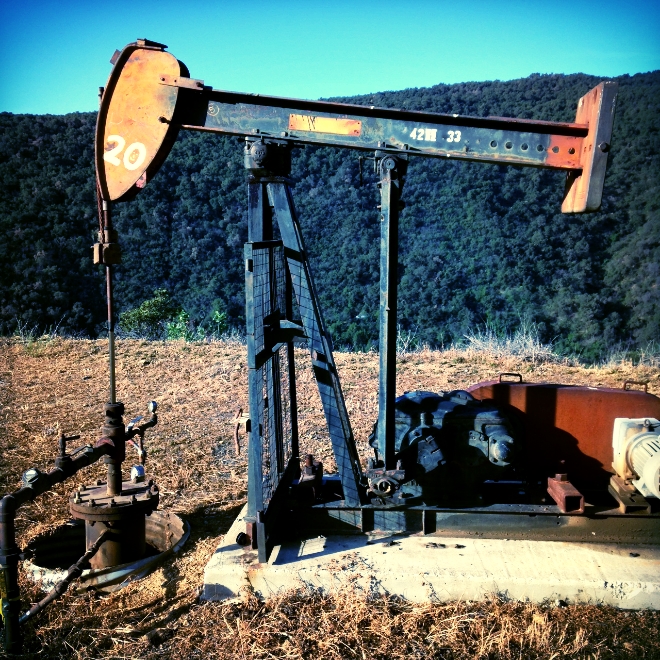
Sounds like early mornings in Upper Ojai. Missing only are shepherds playing small bone flutes, their wives following in their wake spinning wool between distaff and spindle whom Fermor describes populating these wild reaches of Transylvania;  but on cold mornings here in the Upper Valley there is the thrum of wind machines stirring the gelid air and dispelling the icy fingers of Jack Frost as he grabs for the tender citrus; at other times, the creak of pump jacks and the fluttering orange flag that is the nearby gas flare animate the scene. The settings are similar: the ancient human rituals of sheep herding replaced by automatons or, on Wednesdays, when Harrison sends giant trucks that grab our garbage cans and upends them over their gaping maws, before peremptorily setting them down again and departing in search of fresh canned prey - their human operators almost entirely invisible - by a mechanical ballet, staged against the stunning backdrop of chaparral, mountain and sky.

We get by, somehow, without a roster of Arcadian extras to flesh out the bucolic scene. Shakespeare called these all too human bumpkins 'mechanicals'. We have attempted to dispense with flesh and blood in this postindustrial world and the bumpkins exited stage left some time ago; our service workers are made invisible in the interest of creating the flawless, non-human, technological surface that threatens to shrink wrap our existence. Now we see little of our world being made (but suspect that much of it may be happening in the Middle Kingdom) the better to function as creatures of unalloyed desire – units of economic consumption.

In the village of my dreams there are cottages, workshops, crossroads, a church, a farm, stables, a dairy and dark, inscrutable barns. There's a blacksmith at his forge, a farrier, a butcher, a baker at his ovens and a candlestick maker. There’s a thatcher, a brick maker, a carpenter and a tinsmith.

There are shops - a butcher, a green grocer, a grocery store, a bakery, an ironmonger, a toy store, a book store, a stationers, a newsagent (because these reveries are often sourced by memories of England) and a bank.  There’s a laundress, a tailor, a tanner and a gunsmith; even a furniture maker, a seamstress, a tailor and a cook. There is a winemaker and a brewer, a schoolteacher and an undertaker; a farmer, a jeweler and a silversmith; a woodcutter and a miller, a stone carver, a cooper and a wheelwright. There are agricultural laborers and ditch diggers - and Gypsies. At the crossroads there is an inn.

There is  doctor and a lawyer, even an Indian chief (outside of the tobacconist); a fortune teller and a story teller, a bank teller and a musician, a soldier and an artist, a sign painter, a poet, a dancer and a druggist; a witch and a wizard, a cobbler and a preacher. 
At a distance is a benign despot, The Good King.

Just your average chimerical village - where human activities are clearly attached to material benefits, life processes are attended to by living beings, and our nourishment conveyed to us by its farmers and its cooks, its processors and packagers; where the business of survival (of community, of life) is transparent. Where, in the daily round, the moving parts, the actors and the hangers-on, the movers and shakers and the mechanicals, are all on full view. A life where there is clarity of exposition. An existence where we understand the plot: where we know what's going on for chrissakes. We should be so lucky.

It is in our dreams, in our fairy tales, our myths and our imaginations that we seek exegesis: simple explanations for complex operations - or in economic theory. The fairy-tale village may be a  construction of our childhood imaginations, built at a time when we remain mostly unaware that a taxman is lurking to enforce the social contract that each and every one of this happy throng (except, perhaps, for the itinerant Gypsies) has made with The Good King. Only later do we realize exactly of what those fairy tales had been grimly hinting – of the menace hiding in the bushes, of a wolf waiting to garnish our hard-won wages.

The Carpathian moment in Paddy Fermor’s sepia-tinted youth existed during the erratic rule of the Rumanian King Carol whose government swung between royal absolutism and an indigenous fascism. A brief alliance with Nazi Germany then led into the long night of Soviet domination, which reached its apogee in the nightmare of Nicolae and Elena Ceausescu’s dictatorship which lasted almost a quarter of a century, from 1965 to 1989. Through it all, victors plundered the vanquished whether by taxes or privation. Fermor saw an Arcadian idyll which, if it existed at all, was perilously brief and owed much to his own romantic vision when seen at first hand then further mellowed by the years through which his journey was recalled - something like the illusory village that lodged in my own callow imagination and that I now, many decades later, happily visit.

 But we need to go back further than an idealized village, that figment from some golden age (reifications of which Fermor wanders through in Eastern Europe), to find The Happiest Place on Earth, in a Magic Kingdom (and that kingdom, of course, was not a kingdom at all), far, far back into time, before a long ago global warming presaged the end of the ice age and of the mega fauna that ranged the open tundra. So far back, that neither is it a village; so far back that this ‘it’, this nirvana, preceded the development of agriculture and of what Kojin Karatani calls “The Sedentary Revolution” (The Structure of World History, 2014).

Karatani makes the point that economic activity began with the pooling of resources within bands of nomadic hunter gatherers; they also practiced reciprocal gift giving with outside groups. There was no incentive for nomadic peoples to store food – instead, they moved to an area where fresh supplies could be obtained. Acquisition ran counter to the nomads’ need for mobility and as long as there was room to roam and mega-fauna to hunt there was no reason to settle – where conflict was more likely with outside groups and, within the band, social malcontents could stir resentments; neither was there any desire to reside alongside their dead: far better to bury the departed and move on.

Between ten and fifteen thousand years ago, as the ice was melting, the steppes and prairies began to be forested and the great herds of mastodon, giant bison and other megafauna began to diminish. At the same time, increasing seasonal fluctuations in weather made foraging a less successful year-round activity. Global warming thus generated conditions prejudicial to nomadic hunting and gathering and fishing began to be of increasing importance to humankind’s survival. River bank settlements became proto-villages. Smoked fish created the first opportunity for the stockpiling of food - initiating the long history of resource inequality. Food supplies were soon augmented by the herding of domesticated livestock and the cultivation of crops. Notions of ownership developed that established the rich and the poor, those who had and those who had not.

 As the climate warmed and the rivers ran more freely, construction of permanent settlements dependent on agriculture initiated a complex syndrome we know as Civilization - what Jared Diamond characterizes as “the worst mistake in the history of the human race" and with it, the degradation of the planet.

 Human labor began to be commodified - something bought, sold or stolen. The weak toiled for the strong; leisure for the few replaced leisure for everyone.  For the many, it was in Civilization, rather than in Hobbesian Nature, that life became nasty, brutish and short.

 Long, long ago, the happiest place had been no-place - where there was little thought of tomorrow and little memory of yesterday. A filmic succession of places, a songline, a journeying embedded within the pulses of the planet as it pursued its irregular orbit around the sun, informed all of human life.

Only the sick and dying were sedentary, confined to one place: the village of the damned. 

April 26, 2015 /john davis
Comment

Earth Dusted

April 11, 2015 by john davis

Peter Schjeldahl, art critic for the New Yorker, responded to a question on whether the art world was broken with,

 "Franz Kafka once said there is infinite hope, but not for us. I guess that would depend on whether you include yourself in that us or not. There's infinite hope. People get up in the morning and make art, look at art, think about art, and sell it. No, the art world isn't broken".

The world of the Lakota Sioux, indeed of all the Native tribes that once rode over the North American Plains on horses bred from those originally stolen from the Pueblo Indians of New Mexico (who in turn had acquired them from the Spanish at the very end of the sixteenth century), was very thoroughly broken by 1890, when the last of their tribe was massacred by the U.S. cavalry. Examples of the art produced in those two hundred years by this nomadic Plains culture - or rather the housewares, clothing, weapons, tipis  and ceremonial costumes, that are now considered as art - is on display at the Museum of Metropolitan Art in New York in a show that originated in the Musée du Quai Branly in Paris.

The American military, newly practiced at and equipped for industrial scale killing, effectively eliminated Native Americans from the Plains between the end of the Civil War and the close of the nineteenth century. Their art is now enshrined in a bastion of New York's institutional establishment (originally funded by those railway magnates, land barons and nascent industrial magnates whose lust for profit doomed the very existence of its makers), lauded in Paris, and critiqued in the New Yorker (Moving Pictures, Mar, 16, 2015) . Their lives taken, now their culture is consumed by Western Imperialist, running dog capitalists and fetishized by their cultural storm troops, the art elite.

How else to interpret Schjeldahl's crass dismissal of the Native American genocide with the bland "what ensued is a story of reservations........But there's an ameliorating epilogue of revivals and transformations of Plains heritage"? Huh? Whatever mannerist reflections still bubble up from those genetically related to the people of these once vibrant cultures in no way absolves the epic criminality that attended their original, nineteenth century, pre-meditated destruction.

Karl Ove Knausguaard asks in My Saga, NYT, March 8, 15, "....the Vikings... discovered America, but they left it, almost without a trace. What if Columbus had done the same?" What if, he conjectures, " the Europeans had said simply, "Let's leave the New World in peace, out of respect for the people there and their way of life," what would the continent look like now?"

The answer, of course, is little different from then, if the land and its peoples had truly been left isolated from the rest of the world. As a thought experiment it reveals a deeply disquieting question: the Met warehouses artifacts from dead and dying pre-modern cultures of the world - what, if anything, makes our one global mono-culture of greater value than these myriad expressions of being? In submitting to the urge to expunge the primitive (retaining only the mute testimony of its surviving artifacts) what damage has been done to our psychic karma?  How wounded are we, as Americans, by our close temporal, geographic and cultural links to those whose genocidal impulse erased the cultures of the land we know as the United States? Now, our Imperial blood-lust dominates our relationships with other nations of the world - a lust weaponized with the frightening capability of terminating the entirety of Earth's human cultures; leaving perhaps, a few carbonized and radioactive artifacts for alien beings to eventually collect and fetishize.

In California, some history runs a little deeper than it does on the Great Plains. Local Indians were confronted by the colonial power of Spain, manifested in the form of Junipero Serra and his Franciscan brothers, in 1769. The Missions built along El Camino Real were the forward positions of a religious and military coalition whose goal was the subjugation and Christianization of the indigenous people who then, it was thought, would become serfs in a feudal system of estate agriculture. In the event, the Missions became charnal houses - ground zero in the entirely deliberate extermination of indigenous cultures - architecturally expressed in crude renditions of the provincial Spanish style.

The material culture of the local Southern California bands was highly developed in the realms of basketry and canoe construction but was limited in its decorative impact. Clothing was minimal, a buckskin skirt for women and a simple skin blanket for the men. Sea otter furs were highly prized. Sandals of yucca fiber were worn in rough country but otherwise the people went barefoot. California casual has been in style for ten thousand years or more.

This modest level of personal adornment and the typical utilitarian shelters of reed thatch and brush stand in contrast to the elaborately decorated clothing, painted buffalo hide tipis and feathered head dresses of the Plains Indians; but the bands of Sioux, Cheyenne, Comanche and Blackfoot, who immediately bedizened their dress with glass beads after contact, had formerly lived modest lives as small scale agriculturalists or hunter gatherers.

It was their acquisition of the horse and their adoption of a nomadic culture centered on the hunting of buffalo that has ironically now become the standard perception of Indian life.  The multi-colored, intricately worked artifacts, the buckskin, feathers and red cloth sashes that characterize this short-lived metamorphosis, and that has so entranced us (and the French), was doomed from the start: Anglo-Americans were determined to take the Natives’ range lands and were simultaneously engaged in the mass slaughter of their primary means of material support, the Buffalo.

California Indians endured a slow death well away from this country’s or the world’s attention. It was not until the conclusion of the Mexican America War in 1848, the discovery of gold at Sutter's Mill in the same year, the granting of Statehood, and a little later, the establishment of a rail link across the country that some attention was given to the condition of the Native peoples.

Her report on the appalling conditions of Indians in Southern California ignored by Congress, Helen Hunt Jackson resolved to write a novel dramatizing their plight. Ramona was published in 1884 and was immediately popular but largely misinterpreted as a ‘Romance of the Ranchos’ and spawned a small industry devoted to the romanticization of the Mexican-American Ranchero lifestyle. The impoverished, malnourished and spiritless Indians were no match, in the popular imagination, for the dashing caballeros and senoritas that shared space with them in the novel.

Thus it is that fifteen thousand years of supremely sustainable human habitation, of low-impact, largely peaceable existence and congeries of finely tuned socio-spiritual awareness, have entirely failed to impact the consciousness of their usurpers. For this we should be grateful. The funeral sticks, solstice stones, mano and metate of the Chumash, and before them of the Oak Grove peoples have yet to be collected in global art-world exhibitions. These self-effacing communities of earth-dusted people amidst their earth-dusted clothing, basketry, and thatch, all bathed in the warm Californian light are honored instead by the preservation of their environment – the dour, doughty and drought resistant chaparral: their most un-glamorous companion eco-system, a land that endures now, so little different from then.

April 11, 2015 /john davis
1 Comment
FullSizeRender.jpg

On the Road

April 02, 2015 by john davis

I woke to the white-noise of a city awakening. It is 4 a.m. in Venice and I feel a mild anxiety slowly filling my consciousness tracking parallel to an awareness that I am not in Ojai anymore…..

It’s salutary to spend time in Los Angeles. How else to confirm the joys of living elsewhere? Yet I carry the stamp of an urban-dweller wherever I rest my head: thus it is entirely apt that this blog is titled Urban Wildland.

I am an outlander, an outlier, an outsider. More urban than wild. But I am at home with myself and at home in the chaparral, that entirely useless, but infinitely valuable eco-system that has never nurtured people – where humankind is intrinsically alien. (The Chumash were careful to situate their villages in areas adjacent to a creek and riparian shade trees or in oak-meadowland). Grizzlies, mountain lions, bobcats, coyotes, grey foxes, and their animal prey were the mammalian inheritors of this Pleistocene eco-system and all but the grizzly still dominate its dense thickets. In its cleared patches people now farm, build country estates and horse ranches or, mostly hidden from sight, extract oil. Some, like me, live in isolated houses in the scrub-land with cherished access to the city (via Santa Paula to the 126 with a choice of linking up with the PCH, the 101 or the 5) and relish the frisson of the urban wildland - where our expensively acquired liberal educations allow us to parse the relationship between town and country while avoiding commitment to either sensibility. Mostly, we look at the chaparral as an ancient scenic backdrop to our twenty-first century lives.

My parents were both Londoners evacuated from the city early in WWII and ended up spending the rest of their days in rural Surrey. I was born a few years after they made this move, living in the small villages of Eashing, Witley, Churt, Frensham, Lower Bourne, and then, at age six, moving  to a  new Council house on a small Estate (or Project, as such congeries of Public Housing are known in the U.S.) in Milford, a village that suffers the indignity of having a Victorian era Gothic revival church as its centerpiece - still considered, in the 1950's, an example of brash modernity compared to churches in surrounding villages that typically date back to Norman or Saxon times.

My parents were neither locals nor did they maintain cultural and economic roots in London, as did those families whose bread winner traveled daily on the British Rail Southern Region line to Waterloo Station. My father briefly commuted to his insurance job in the City from Churt, but quickly tired of this routine and resolved to work locally. By the time we had arrived in Milford, to live in public housing, we had forfeited any pretensions to belonging to the middle class and settled into our lives of alienation, physically within but socially firmly outside of the stock-broker belt and never likely to be considered country folk, certainly not a part of the local gentry nor, with my father employed as a small time insurance agent, ever likely to ascend to the professional classes. 

Compounding my estrangement from any comfortable niche within the English class system was the fact that both my parents, but particularly my father, had upper- middle class accents of which my dad was very protective and concerned that his children inherit.  After the age of nine I was banned from playing with the local kids for fear that I might pick up a Surrey accent. 

A couple of years after leaving High School, in 1967, the inconsistencies in what might be called my class affect (I was the embodiment of false consciousness) were such that leaving England seemed the only reasonable course. 

In the spring of 1933, a similarly tumultuous time, and perhaps for some of the same reasons, Patrick Leigh Fermor, at eighteen, left to walk from the Hook of Holland to Constantinople. He was an assiduous diarist and eventually turned the material from this epic stroll through Europe between the wars into two books that made his reputation as a writer; a third volume was published posthumously. Although he went on to live an extraordinarily rich life, it was the memories of his walk across a continent that fuelled his literary production into his old age; they remained the well spring of his creative life.

Fermor, who was thrown out of every school he ever attended and never went to a university, acquired great learning at an early age from an adoring mother who was a fashionable haute bohème in London and a famous geologist father resident in India, who introduced young eight year old Paddy to mountain climbing in the Swiss Alps; together they provided enough contacts in Europe's fading aristocracy to assure comfortable lodgings when the boy was not sleeping rough in some remote field or abandoned shepherd’s hut. He also had a weekly stipend of one pound that kept him in food and drink while he was 'On the Road'. 

My journey away from England began by hitch-hiking to Dover and boarding a cross channel ferry to Ostend in Belgium. It was the first time I had left Britain. My previous hitch-hiking experience was mostly limited to Gloucestershire where I had briefly attended the Art College in Cheltenham. It was April and I had a kapok filled sleeping bag. As I recall, I slept rough the first night and then hitched to Paris, then on down the RN-9 to the French Riviera. My first night in a bed was somewhere in Provence - courtesy of a couple who were on their way to their country house. The next morning I was taken to the appropriate route by the husband in his gull-wing Mercedes. Fermor would have moved in for a week and made life-long friends – my almost complete lack of French, despite studying for five years, limited my entertainment value after the first flush of vagabondish appeal. I was, however, given the address of their son in Nice, who was about my age, and I looked him up upon arrival. A deeply entitled young man, he had little time to waste on a provincial lad from England intent on the romance of travel and totally incapable of sampling the wealthy youth culture of the Riviera. I hitched through the string of glamorous resort towns and headed for Venice, Italy.

Emblematic of a trip that wandered across Asia and then ran out of roads in Colombo, Ceylon (now Sri Lanka), I saw the sinking city only through the haze of Northern Italy’s industrial smog: an early success in avoiding the culturally sanctioned sights, lightly sacrificed for the greater thrill of journeying onward and Eastward.  

Now, I find joy in looking north through the foothills to the Topatopas, knowing that onward is a wildland that stretches to Bakersfield and beyond.  It is here, I imagine, that resides the primordial soul of California, nurtured long before people journeyed down the kelp road (in the familiar marine environment that holds constant all the way from the Aleutians), forged in the maelstrom of colliding tectonic plates, pullulating coast lines, disappearing inland seas and finally, grinding mountains of moving ice which, in a warming world, puddled into great rivers, aquifers and lakes.

In my rear view mirror I see the vast conurbation of the Southland, from the teeming tenements of Tijuana to the broad coastal plain of Los Angeles, bounded by the Santa Monica Mountains and the San Gabriels, where lives a virulent urban culture that leaks through the canyons and passes, floods the San Fernando valley and is finally sated somewhere just north of Oxnard and the City of Ventura - all woven together with the sinews of a profoundly twentieth century transportation system that found its apotheosis in the freeway.

Somewhere between these hulking, mythic realities lies the urban wildland. It is in this precarious interstice that I have found my place.

April 02, 2015 /john davis
Comment

Triple Cream

March 18, 2015 by john davis

With a stiff neck from watching a one hundred and fifty minute film, I walked out of the Riviera Theater in Santa Barbara on the first day of daylight saving to see a viscous twilight settling over the bay.  Lights had begun to appear across the darkling plain of downtown and at the shore's edge, a white twig-like line illuminated with strings of light was etched into the bay - Stearns Wharf: reduced by distance and the scattering of light through the dust and pollution of earth's atmosphere to a filament, a tiny scratch on my retinal canvas. 

I had, indeed, just seen Mr. Turner, Mike Leigh's grand biopic of the early nineteenth century painter. I was primed - stretched and gessoed - ready to receive the faintest optical stimulations of atmosphere, earth and ocean. What I got, as I blinked into the early evening's light, was a cineramic shot of the edenic, sub-tropical, crepuscular, Southern Californian, Spanish provincial revival, stage-set  fantasy that is Santa Barbara seen from the Elysian heights, above the Mission, on Alameda Padre Serra. 

The Riviera Theater is housed in the auditorium of the old Normal School of Manual Arts and Home Economics, built in 1909. The campus later morphed into the original setting for UCSB. Improbably, the Riviera is the one Santa Barbara screen showing independent and foreign movies. The theater still features a heavy beamed mission-style ceiling and amber wall sconces embellished with a gothic ‘R’. Across the street is the newly re-modeled luxury resort El Encanto which utilizes some of the old buildings from the original dormitories for the Normal School.

Turner painted atmospheres of sufficient viscosity to function as dream catchers  -  he created external matrices tuned to capture inner thoughts or visions that might otherwise never escape the unconscious. His subject matter - from the horror of a burning slave ship to the pathos of an old Napoleonic era ship of the line being towed up the Thames by steam tug or the technological marvels of the day, like steam trains - was enveloped in texture, color and impressionist mood sufficient to  stir inchoate emotions from deep within the viewer.  He elaborated  the captured moment in ways that produce a gestalt of meaning that transcend the prosaic realities  of the  original scene. 

Leigh shows us canvases (prepared by Turner's housekeeper with benefits) painted, smeared, scratched, and smudged so that they reflect  those fleeting moments of visual revelation initially caught in the artist's sketch books. The filmmaker's  graceful camera and economical script bring Turner, his domestic life and loves, his rancorous dealings with patrons and the stultifying Royal Academy, his professional jealousies and above all, his fascination with the world of the Thames estuary, so fully to life that our own relationship to place, light and our lived lives is ushered into that delirious zone where the quotidien is ennobled both by a soulful beauty and tenebrous meaning.

This morning, before dawn, a half moon hung overhead giving sufficient light for me to move confidently along the trail; wind buffeted the sage and stirred the scents of the chaparral; no birdsong yet, but the tympanic breath of the warm air filled the aural void. Random fronds of chamise whipped in the breeze and brushed against my body: my senses thus engaged, they resonated somewhere deep within me.

The painter’s contemporary, Wordsworth, practiced a similar recollection of fleeting events in tranquility and then a transposition into enduring verse. Both artists were assiduous in broaching the concerns of the day while expanding the consciousness of their audience with bravura renditions of purely visual, often natural, phenomena. It has not entirely escaped my notice that I practice a journeyman version of this device of sugar-coating the pill. The compulsion to concretize the evanescent too, is an enduring artistic compulsion - as is the use of beauty to cloak intellectual constructs and critiques: they are at the heart of the artistic endeavor. But the Romantics, and Turner is surely one such, were also engaged in the practice of drawing back the veil: of revealing the sublime beyond the everyday surfaces of the world. 

At first light,  the sky is almost fully illuminated and the sun's impending  appearance is heralded by a yellow wash leaking around the back lit silhouette of the Santa Paula ridge. An ocean of fog creeps slowly up the Santa Clara river delta bounded by the headlands of South Mountain and Point Mugu. Here was a Turneresque background in the chaparral: but the master was more than a painter of seascapes, landscapes and atmosphere: he imbued his scenes with social, historical and economic significance.  Turner would require a foreground, at the edge of the waves of fog, and extending picture plane left. A native scene - a collection of thatched, beehive shaped huts clustered along the Santa Clara River valley, blue tendrils beginning to coil out of the hut's smoke holes and about them, the first flurry of the mornings activities animating the plain - would have served. His was an imagination, typical of the nineteenth century intellect, that slipped easily into past worlds.

Turner's, proto-impressionist paintings shot his viewers half a century or more into the future enabling them to see the world with something that approached a modern sensibility. He attached emotion to the everyday and wonder to the extraordinary.  Karl Ove Knausgaard, that voice of the moment who has elevated the neuroses of the Scandinavian schlub to an art form, writes in My Saga (2015),

"The external has to awaken something within; nothing means anything in itself, it is the resonance it produces, in the soul and in the language, that gives meaning to the thing described."

In the chaparral this week, the externalities stirring my soul are the triple cream blossoms of the native clematis, holly leafed cherry, and elderberry. They have no need of artistic mediation - they speak directly to me. Here in the wildland, the veil may be drawn back, transcending the picture plane, abrogating the word and eschewing the moving image. The prickly, scented, untidy and random profligacy of the dull green fuzz that clings to the earth's crust in Southern California - still, in places, in its primal state - can fully reveal the soulful adumbrations so hard won by the Romantics and now, by the logorrheic Knausgaard. It offers transport to the Universe's infinitude where the romantic spirit may collapse into a vertiginous gyre of the sublime. 

March 18, 2015 /john davis
Comment
OHC.JPG

Owl's Head Clover

March 02, 2015 by john davis

In Brooklyn last weekend, Prospect Park was limned in monochrome only occasionally leavened by a snow plow's colorful livery or a red, yellow, or blue jacket of a runner who had not gotten the memo: black cold weather running gear best complements the snowy wastes of the park. It was a few degrees above freezing and a plow's blade had cleared a dark band of wet asphalt between rippled piles of slush. Across the white meadows and steely grey lakes stood a black filigree of trees that plumed towards a leaden sky. The previous day, half a foot of snow had fallen transforming the park into this visual slurry of white ash and charcoal.

Returning to California, the Jet Blue Airbus 321 takes off and then traces a wide arc out into the Atlantic offering its passengers aerial visions of the snow fringed continent, black and white cornrows of Long Island's Levitt towns, and then the obsidian daggers of industrial jetties carrying oil pipe into the wintry ocean;  then, as I watch (now on the seat-back screen's map channel) the blue silhouette that serves as the plane's pixeled icon turn, in the blink of an eye, towards a crude cartographic representation of the white heart of a mostly frozen land, I plunge again into the dense, multi-lingual, multi-cultural, deeply sectarian, tribally costumed and variously be-hatted world of Patrick Leigh Fermor's magisterial travelogue, The Broken Road (2013).

As a youth, the author walked the length and breadth of pre-WWII Bulgaria, and remembered his journey, with startling clarity, in his old age. I was driven, from Park Slope (and around Grand Army Plaza) then along Eastern Parkway towards Jet Blue's revivification of Saarinen’s spread-winged terminal almost entirely oblivious of the social, ethnic, economic, religious, national, and political enclaves through which I was passing. I glimpsed (and conjectured) along the eight-lane, bifurcated street (and heaven knows, over the continental United States) that there is substantial evidence of our ethnic heterogeneity: yet Levi Strauss' pronouncement in Triste Tropiques (1956) that we are headed for a global mono-culture remains prescient.

On many of Brooklyn's streets, terra-cotta, common brick, yellow brick, brick clinkers, pale rough-cast stone, granite and brownstone alternatively wrap ossified cavities (often encased in dark woods) that once hosted lively communities of worshipers. This borough is famously replete with churches, most dating back to the former city's days as the most, or second most populous in the country. Now, these varied ecclesiastical edifices remain as hulks, massively irrelevant carcasses in a world gone secular - where Mammon has established his patriarchal sway, attended by nymphs proffering votives of enabling technology.

Barclays Center - a rusting, Corten-clad Leviathan seemingly hauled up from the Hudson River on the corner of Atlantic and Flatbush - is a twenty first century corporatized multi-use venue. Here, the many arrive to worship their sports stars and, this spring, for instance, Barry Manilow, Neil Diamond, The Who, Stevie Wonder, and other aging acts still, apparently, of appeal to what, in another borough, is known as the bridge and tunnel crowd; here, they are enraptured in a place which once was at the heart of multi-ethnic low and middle income neighborhood. Sometimes known locally as the 'Slug', this facility represents the creeping Manhattanization of Brooklyn, a dilution of ethnic, economic and. cultural diversity before the leveling impact of a global corporate mono-culture. On some nights, streets that once may have seen a multiplicity of headgear are swamped by a sea of black, Chinese made Brooklyn Nets snapback hats - a sign of the wearer's allegiance to a company of tall, ball-bouncing mercenaries: but I suppose that there is also, in that flotilla of brimmed cloche, some of the same exoticism of which Fermor takes note in a Turkish graveyard where stone pillars marked the graves. He writes,

 “The lower and older ones, chipped, split, tilted askew and leaning at all angles, were crowned with extravagant carved headgear….They expanded like giant pumpkins and vegetable marrows, intricately pleated round a cone, and sometimes a helmet’s point pricked through the bulbous folds; others were coil upon stone coil of twisted linen; yet others, jutting fluted cylinders adorned with aigrettes. What pashas and agas and beys, what swaggering bimbashis, what miralais with mandarin whiskers, could have worn these portentous headpieces?”

The avowed modernist Ataturk abolished the fez and turban (of which the above lithic draperies are all examples) in 1920. The elaboration within, and multiplicity of, social worlds is a defense against cultural entropy – the process where taste devolves towards what used to be called mass culture.

Complexity empowers the human world. Monoculture destroys vitality and facilitates entropic decay. Mark Fisher points out that “Capitalism is what is left when beliefs have collapsed at the level of ritual or symbolic elaboration, and all that is left is the consumer-spectator, trudging through the ruins and the relics” Capitalist Realism (2008).

At the same time, the natural world is increasingly homogenized by the growth of monoculture agriculture, destruction of habitat, the spread of invasive species and by global warming. The bright green weeds of the world are by their very nature, dominator species – bent on global hegemony over the vast variety of the plant kingdom.

Once upon a time, there was a world of plenty and peace. Over this beneficent tranquility ruled the Great Goddess. But it was but a small step to move from Goddess culture to what Riane Eisler calls an 'androcratic' social organization under a patriarchal God where domination of the natural world, women and the physically weak is condoned: where might makes right and where rigid hierarchies of power prevail.  We are the heirs to such a world.

Complex communities of varied ethnicity, taste and culture have long been under threat from the dominator ideology of neoliberal capitalism. A desacralized Nature is threatened externally by the plundering of its economic resources and within it, by opportunistic flora and fauna, abetted by deliberate and accidental, humanly engineered migrations that further degrade native ecosystems of their complexity and stability.

Long before the godhead was anthropomorphized, human societies lived in worlds of enchantment where there was a recognition that the infinite energy of the universe existed in all things. Then, the human task was to propitiate all that they touched in supporting their livelihoods and worship all that surrounded them. Then, men and women were equipped with egos that remained subservient to the world soul, and humankind's chthonic unconscious acted like a pervious membrane that allowed for the universe to flow in and human intention to flow out.

Drifts of owl’s head clover are set in a lush backdrop of weeds. The plant's slightly purpley red pin-cushion flower heads rise above a sea of alien grasses, clovers, and the irrepressible erodium. The trails through the chaparral that a couple of weeks ago were rock strewn dirt tracks are now grassy, virid veins that thread through the dull brown green and shadowed wild lands. It has rained again: New York's snow echoed in Ojai by half an inch of warm rain. Imported, European sourced chlorophyll is rampant: there are places that look like gimcrack evocations of the Emerald Isle.

This morning I awoke to the steady drum of rain on our metal roof. At first light I saw the Topatopa bluffs were rimed with snow that clung to ridges spread across the spalled sandstone - the dark rock banded in white. To the east, the Santa Paula ridge was lightly dusted while its conical peak was white with snow. Below, as light began to stream over the upper valley, the chaparral remained its dour, somber self; at its edges, meadows, the bright green of trails, and weedy roadside verges pulsated with a manic vigor.

 For a moment, I am transfixed again by the clover, lost in its exuberance and its native beauty. I am enchanted - transported  to a more complex time (paradoxically), long, long ago, when magic inhered in the world.

March 02, 2015 /john davis
Comment
bd10.jpg

Blue Dicks

February 11, 2015 by john davis

Sometimes a Blue Dick is just a Blue Dick. But these native hyacinths also appear, after a storm of ceanothus blossom has blown through the chaparral, as harbingers of spring. We have arrived at that time of the year, at least in Ojai, when we are again reminded by the creaking of the seasonal gears that all of life is transitory - that nothing lasts forever. The entire planet is date-stamped.

Heading into the holiday season, what passes for our winter – an occasional cold snap or rainy day – held a firm grip on my imagination: Spring was not even the palest glow on the edge of the event-horizon. Six weeks later, I am inclined to believe again in the reliability of the celestial clockwork.

Another spring is also heralded by the sickening candy-pink of prickly phlox flowers, often alongside more demure corn-flower blue solanum and white, wild cucumber blossoms. Crinkly leaves of soap plant are emerging from the hard-pack and goosefoot (Chenopodium californicum) is in full leaf. Poison oak gleams malignantly from its shiny new foliage. The native peonies are almost done, true denizens of the topsy-turvy world of the chaparral where plants flourish in winter and begin to wither and die in spring. High on a hill, California poppies nod toward the south. Owls head clover has appeared in the meadows. Lupins are flowering and blue Ceanothus spinosus, which blooms a few weeks later than the white varieties (whose massed polar clouds are now diminishing), is freshly in evidence. 

It’s that time of the year on Rodeo Drive in Beverly Hills when spring and summer collections are on display in the flagship stores of international brands that line both sides of the street between Santa Monica Boulevard and Wilshire; (within too, a courtyard mall that worms its way into a surrounding block and along a street that wriggles through another section in the development parterre).

Just a week ago, walking along these bastions of early twentieth-first century global-consumer capitalism (sound track supplied by Maserati and Lamborghini as their pilots trawled the gold-paved streets) deep in the maw of our profoundly egocentric culture, I was reminded how different is the experience of living apart from such displays; of how my psyche has been split asunder living in Upper Ojai where the portal that yawns before me leads not towards Ralph Lauren’s new spring/summer collection, but directly into the World Soul.

Lorrie and I were headed to a restaurant to meet friends: Chinese tourists bustled past us clutching their newly bought fashions, equally available in Beijing, Shanghai and Hong Kong - and perhaps other Chinese cities of which I remain unaware; but here at the heart of the American dream, their goods come branded with the unique frisson of having been purchased on Rodeo Drive (on a warm winter’s afternoon). Here too, global brands are richly burnished by the triple imprimaturs of the eponymous Hillbillies’ town, Los Angeles and Southern California. Rodeo Drive represents, for the out-of town, lustful consumer, a quadruple threat.

Cloistered beneath the crumbling face of the Topatopa bluffs, I daily face a similarly multitudinous threat to the erstwhile sanctity of my ego. That’s a good thing. Jung re-established the eternal truth that the earth is more than matter, it is spirit. It is that spirit that now erodes the primacy of my ego, nurtured in some of the most consumer-centric cities in the world – London, Sydney and Los Angeles. Walking down Rodeo Drive represented a mannerist mirror to my past, a ghastly, glittering apparition of the road not taken. For in each city, despite being lured by their urban surfaces polished by desire - by the continuum of fashion-driven development over the ages - I have also found some refuge in more elemental circumstances: the woods and downs of darkest Surrey, the beaches and bush of Sydney’s North Shore and the bay beaches and chaparral edges of Los Angeles. Now in Ojai, I am able to fully allow what Jung called the ‘conditioning of the mind by the earth’.

David Tacey, in Edge of the Sacred – Jung, Psyche, Earth, Daimon Verlag, Zurich, 2009, explains. The history of human spirituality has been divided, he suggests, into two broad streams: the sky-pointers who see the heavens as representing the sacred realm and the earth-pointers who understand that the sacred inheres within the earth. These two distinct spatial heirophanies are represented on the one hand by the major monotheisms and on the other by polytheistic animism. This spatial mapping of the sacred is reflected, in Jungian terms, within the human psyche.

For Jung, the psyche included both conscious and unconscious psychic processes. How the elements, or forces, within these processes are resolved results in individuation. The ego exists at the center of the field of consciousness and stands guard at the border of the inner and outer worlds. The unconscious is the repository for all past and future thoughts and repressed emotions which are not being experienced in the moment.  Within the unconscious there resides the shadow, an underworld that aggregates the parts of ourselves we most fear as well as the intelligences that reside in the collective unconscious, or group mind, and ultimately, is attuned to the World Soul.  For Jung, it is the shadow to which the earth speaks.

In the global north, at least since the Enlightenment, and arguably since the rise of patriarchy and monotheistic religion, the ego has enlarged its domain within the psyche at the cost of the shadow within the unconscious. Thus the earth has increasingly gone unheard.

The shadow world of the subconscious, what Jung calls the chthonic portion of the psyche, was fed by the ancient religions of pre-modern humanity. Jung notes that ‘dark powers, witches, magicians and spirits’ represented the forces of the earth and these archaic forms held sway over an emasculated ego in primitive humans. But this form of magical thinking was undermined by the rise of science; Jung writes,

“This was the first stage in the despiritualization of the world. One step followed another: already in antiquity the gods were withdrawn from mountains and rivers, from trees and animals”.

Jung posits, in his Terry Lectures from 1940, that the dominant, modern form of thinking leaves us bereft: in a spiritual and emotional wasteland where the earth has become desacralized and is plundered to satisfy our gross egotistical desires. Thus he predicts the psychic roots of our growing environmental crisis.

Yet spirit still inheres in the land. The spirit dynamics of the earth can overturn and replace the aspirations of the ego. Material desire can wither and die as connections are made with the natural world. The shadow can rise again and fully inhabit the unconscious creating a base of spiritual profundity that can heal the individual: in society, such a realignment might heal the planet.

Here, where all is sky and bio-mass, damp earth and trickling streams, is a world that calms - a world that subtly shapes one’s psyche. On a meadow, just up the road, blue dicks rise out of the grasslands, or sometimes push out of bare, sun-splashed rocky soil. Violet blue, their flowers are the color of the heavens: but they direct our attention not towards the empyrean, but to the spirit earth, where primordial forces may one day link again with humanity and bring an ecological order to the planet.

For the Chumash, this plant they called Shikh’o’n was a valuable food source. Their bulbs were roasted in communal lily (Brodiaea) roasting pits (Timbrook). It was a beloved plant that featured in their tales of Coyote trickery: it was deeply rooted in their magical thinking.  It helped sustain, as did all things of the earth, their psychic balance within a world of enchantment. More than a harbinger of spring, it represented a complex spirit essence; it spoke to the deep chthonic streams within the Chumash psyche.

 This early spring, it spoke to me.

February 11, 2015 /john davis
Comment

Candy, Candy

January 31, 2015 by john davis

In the burgeoning bohemian capital of Ojai (as Architectural Digest gushes in a recent blog piece), we live at the vortex of a luxury market devoted to an ethos of the organic, natural, hand-crafted, and locavore.

There’s no denying the appeal of artisanal foods, small-batch beverages and locally-sourced goods made from natural materials. Yet the market for such products typically exists, in the Global North, in wealthy societies underpinned by an antithetical means of production – corporate capitalism.

How do we live with this paradox?

The prevailing goods and services and means of communication across the planet are the products of advanced technologies that have been created with the deliberate goal of reducing the amount of hands-on labor involved and concentrating the profits of such endeavors into the hands of the few.

This phenomenon was enabled in the sixteenth and seventeenth centuries with the development of a highly focused and reductive way of looking at the world known as The Scientific Revolution, and its practical adjunct, The Industrial Revolution. Advances in weaponry, navigational technologies and transportation enabled peoples from countries who first adopted this new outlook to colonize great swathes of the planet and use foreign labor and raw materials to enrich their own societies. Thus we have the familiar tale of modern civilization: a world founded on the twin pillars of rational scientific analysis and greed. It replaced a pre-modern age of manual labor, hand crafts and food and drink that, even if often scarce, were always organic.

During the eighteenth and nineteenth centuries, increasing mechanization of large scale agriculture reduced the number of jobs available to rural populations and made available a vast labor pool for the new industries of mass production. A similar process continues to play out in the so-called developing world today. A universe of artisanal production and small, mixed farms of crops and livestock is being replaced by hugely productive, artificially fertilized mono-crop agri-businesses and meat factory farms tied into a global distribution system, enabled by the fossil-fueled internal combustion engine. Displaced rural workers, over the generations, have become fully enmeshed in the modern world, overwhelmingly as passive consumers rather than as active producers.

Yet we continue to crave the organic artisanal foods and hand-crafted goods that once were our birthright and in Ojai and select towns and suburbs throughout California, they are readily available, marketed by an array of local providers. We may even fantasize about a universal reversion to organic farming methods, localized production and hand-made goods: but we are dimly aware that such a transition might entail the destruction of corporate capitalism along with all the financial, health, food, communications, transport, scientific research, education and consumer goods  that the system supports. For most people too, their livelihoods (and their ability to purchase artisanal luxuries) depend on the maintenance of that system.

Patti Smith, who played the Granada in Santa Barbara recently, has the answer.

She sang,

I had a dream, Mr. King, if you'll beg my pardon
I was trespassing a sacred garden
And the blossoms fell and they dropped like candy
And the nature cried, "Gandhi, Gandhi"

And then,

Long live revolution and the spinning wheel
Awake, awake is the mighty appeal
Oh, people awake, awake from your slumber
And get 'em with the numbers
Get 'em with the numbers……

The numbers are indeed what it is about: the planet’s ability to support over seven billion people depends on the cruel system of production and reward the powerful have devised over the last half millennium and whose viability is profoundly dependent on the ravaging of the natural world – of trespassing a sacred garden.

This week, the chaparral has also spoken. Ceanothus blossom is dropping like candy. Nothing is as sweet in the local elfin forest as buckbrush (Ceanothus cuneatus) in bloom. The Santa Ana winds of late January have scattered the tiny white petals across the chaparral trails. On still days the sweet scent hangs in the air:  anchored by a dark, honey fragrance freshened by herbaceous sage-like top notes it is redolent of the nose of a vintage Sauterne; of floral candy.

Gandhi used a spinning wheel as a symbol of self-sufficiency: it represented a way to replace industrially produced clothing with self-spun khadi cloth dhotis, lungis, kurtas and sarongs. His was a vision of self-employed small farmers and craftspeople who lived in small villages rather than cities and derived their livings entirely within the local community; governance, to the extent that it was required, would be organized through consensus driven village assemblies.

Gandhi was adamant in his opposition to the centralized, industrialized, and mechanized modes of production that the British had developed and he fully understood the impact of India’s economy becoming subservient to that system. He preached, “Not mass production, but production by the masses”. Transportation in traditional, rural India is by foot, bicycle and ox-cart and Gandhi saw no need for further elaboration. One of the great symbols of Britain’s command and control of the sub-continent was its vast network of railways:  Gandhi understood its true significance as a conduit of imperial power.

We are now, ourselves, mostly colonial subjects of multi-national industrial capitalism: a system ultimately upheld by governments, legal frameworks and militarized police forces. Notions of the organic, natural, hand-crafted, and locavore are a subset of broader concepts of sustainability, localism and democracy.  Gandhi’s idea of Swadeshi, or home economy, retains its relevance: there can be no genuine embrace of the local without breaking the bonds of a globalized economy.

Our fetishization of organic food, natural fabrics and homewares fits neatly into the prevailing economic model as a high-end, boutique market ultimately sustained by consumers fully embedded within neo-liberal economics and the industrial modes of production, transportation and communication it enables.

If we are to awake from our slumbers and get ‘em with our numbers, it will take a little more commitment than shopping at the farmer’s market, driving a Prius and enjoying device-free home-cooked meals with our families.

Clouds of ceanothus blossom have emerged from the chaparral.  Surely, in Ojai, we can hear nature’s cries of “Gandhi, Gandhi”?  The blossoms have dropped like candy: it’s time to get our dhoti on.

January 31, 2015 /john davis
1 Comment
12.jpg

The Long March

January 22, 2015 by john davis

In Blood Meridian (1985) Cormac McCarthy writes of the Sonoran desert,

“…here was nothing more luminous than another and nothing more enshadowed and in the optical democracy of such landscapes all preference is made whimsical and a man and a rock become endowed with unguessed kinships.”

In such wildlands, he seems to suggest, individual consciousness and even morphic distinctions evaporate beneath the Universe’s gaze. In these landscapes too, something similar happens to time. It expands to become the eternal now. Left behind in the cosmic dust are such pettifogging notions like: the future is unknowable, the end is near and the past is a foreign country.

Moment to moment, experience is immediately consigned to the past but is used, in that moment, as a guide to the future. It is in these realms of memory and of conjecture that most of us, in our daily lives, reside. Despite our best intentions of being present, we exist in a netherworld where our thoughts structure our experience - their surge and back wash constituting our notions of the past and the future - the present consigned as nothing more than grist to its mill. Thus it is that we are trapped temporally within a current flowing between past and future.The Time Lords are remorseless in their dedication to vanquishing the present.

In the world of the Chumash, enmeshed in their wildlands - fully present in their animist universe - there was an escape from the smothering folds of past and future into the knife-edge of the now. It’s a hell of a way to live, but perhaps the only way to be fully alive.

Early in January, I drove into Chumash territory north and east of Santa Barbara. Perhaps more accurately, I drove north into Chumash Casino territory, for it is this palace of fine dining, entertainment and gambling that is now the most visible symbol of those who claim a genetic link to the native American tribes that shared similar languages and cultures from Malibu in the south to Ragged Point in the north, along coastal plains bound by the Santa Monica, Santa Ynez Mountains and, beyond, by the San Rafael Mountains and the Santa Lucia Range. The supposed forbears of the Santa Ynez Band, who now look to the casino for their wealth, were effectively exterminated, along with all of their Chumash brethren, by the Franciscan brothers, ably led by Junipero Serra, with mop-up operations conducted by Americans who flooded into Southern California in the mid-nineteenth century. So it was that the tribe’s eternal now, which lasted for at least 13,000 years (Erlandson), was effectively ended by the beginning of the twentieth century.

While Indian consciousness may have endured in a state of immediacy, the people ever receptive to the sensory impulses of a constantly numinous world, their physical setting was undergoing massive change. As the climate warmed at the end of the last Ice Age, sea levels rose dramatically along the southern Californian coast - by as much as 400’ north of Point Conception along more exposed coastlines. During the melt water pulses of 13,500 and 11,000 years ago the rate of rise was between six and thirteen feet per century (Masters and Aiello, Postglacial Evolution of Coastal Environments, 2010) inundating vast areas of the coastal plains that had originally been inhabited by California’s first settlers.

Much of the evidence of these Paleo-Indian people is thus buried beneath the ocean, along a now submerged coast. It is at least partly because of this buried archaeological treasure that there is now growing support for the designation of the Chumash Heritage National Marine Sanctuary to fill the gap with sanctuary protection between the Channel Islands and the Monterey Bay National Marine Sanctuaries.

Meanwhile, I was far in-shore, ensconced for a few days in Los Alamos, originally part of the estate of La Purisima Mission. In 1839 the land was granted, under Mexican rule, to Antonio de la Guerra as Rancho Los Alamos. By the 1860's it was a popular stagecoach stop en route to San Francisco. The Union Hotel was opened in 1880 on the main street (Bell Street) and survives still as a kitsch curiosity, rivaled only by a truly hideous 1864 Victorian mansion which stands close by and is now operated as a themed room bed-and-breakfast. The town was a stop on the narrow gauge Pacific Coast Railway which ran from Los Olivos to San Louis Obispo from the 1880’s through the early 1930’s as both a passenger line and a freight line servicing the agricultural and oil industries. A former freight shed still stands in Los Alamos and now houses an antique mall. When I first visited fifteen years ago, the town seemed to echo with a death rattle as semi-trailers rumbled past lots left vacant since a devastating 1893 fire and empty storefronts.

Long ago, a Chumash village sat amongst the cottonwoods that run through the valley. As its population was impressed as newly baptized neophytes in the early 1800’s they quickly succumbed to the colonists' introduced diseases and the enforced labor required by the Franciscans at the nearby mission. An 1840’s small pox epidemic struck the last of the Indian population and by the mid-1850's only eight natives were left in the valley.

The town is in the process of being resurrected from this forlorn history as the northern outpost in the food and wine triangulation of the Santa Ynez Valley, anchored by Los Olivos and the town of Santa Ynez. The Chumash Casino is a meretricious outlier to these bastions of the haute bourgeoisie and their junior acolytes, hirsute and inked hipsters. Withal, the jewel encrusted dead hand of hyper-capitalism, here conjured by the twin cities of gold, Los Angeles and San Francisco, lies over the lean and racy wines and the field fresh food of this clustering of new restaurants, delicatessens, bakeries and tasting rooms.

The Spanish arrived in California determined to develop feudal estates around their mission system using the native population as serfs. Thus even as late as the eighteenth century, Spanish colonial rule hearkened back to the feudal system but here in California the model collapsed in a plague of introduced diseases and famine. The intended broad base of compliant laborers died in mission, field and their erstwhile villages, in an unintended genocide.

Around Purisima, the land then passed into the rancho system where remnant Indians and low-caste Mexicans served their aristocratic masters (many newly minted) and thus replicated, slightly more successfully, the medieval economic system. This comparatively benign feudalism was then engulfed by the gold rush that opened up the 31st. State to mercantilism before agriculture, oil, shipping, real estate, banking, tourism and entertainment finally moved California into a mature capitalist system.

Contemporary cultures, driven by neo-liberal capitalism, have now fully abandoned the present: they are, instead, consumed with the future. Los Alamos has been shaped over the last one hundred and fifty years by competing visions of transport – from stagecoach to railroad to the original route of the 101, and is now being revived by notions of how we might eat and drink in an idealized future where artisanal practice somehow trumps the pervasive world-reality of industrially produced food and beverages. The past is fetishized by re-purposing the town’s buildings from the late nineteenth and early twentieth century as emporia of twenty-first century boutique consumption.

This morning, a still sea of mist lay over the Santa Clara River in a faint visual echo of the roiling melt waters that first carved the valley.  Far above, in a chaparral canyon which funnels a tributary towards the river, the heavy scent of ceanothus blossom hung in the air while the sound of my breathing, my footfall and bird song further occupied my senses. For a moment, I escaped into the now. I eluded the Time Lords, whose rule began in the waning days of the dark-ages when hunters, gatherers, woodsmen and fisher-folk were first organized into a laboring under-class to serve the aspirations of the rich and powerful: the first step in our long march to the future. Under their unrelenting tutelage, we have consumed the present.

January 22, 2015 /john davis
Comment
11115-45.JPG

Dawn

January 05, 2015 by john davis

I leave at first light: into a world of monochrome and mystery. I attend the re-birth, the becoming. The moment when the story of our planet, over the last ten thousand, one million, two hundred million; no, four point five four billion years, is re-substantiated, each morning (thus far) as the sun first washes the sky with its incandescence.

I am loathe to leave the mire, the murk, the half-light: but inexorably the earth catches fire and slowly assumes its morning colors. The chaparral is as reluctant as I am to embrace the morning light: its drab green lingering still in the darkling. The blonde thickets of dead mustard stalks and tumbleweed along the roadway are the first to reflect the early glow – skeletal non-natives seemingly crowing to the world of their colonial triumph, accompanied by the trumpets of dawn.

As the sky brightens, the pencil line of a jet contrail is drawn across the northern sky. To the east, flecks of apricot appear to float in a milky soup. The still dark Oxnard plain is wreathed in grey-blue mists and the distant Santa Monica Mountains recede in ever-lightening ranks until they become one with the heavens. But the sinews of the industrial state have begun to emerge from beneath the cloak of night. The road’s fog line, yellow double center line, the airline, the fence line and the oil pipeline reassert their Cartesian grip on the amorphous shadowings of the dark. Only the natural gas flare in the oil patch at the top of Koenigstein reverses the process of dawn’s revelations– its bright flame slowly drowned in the sun’s emerging candlepower. Meanwhile, the antic silhouette of the pump becomes ever more emphatically etched against the sky.

Yes, it’s that time of year again when Hanuka, Solstice, Christmas, New Year’s and my birthday conflate into one almighty hammer blow to my consciousness. A moment of reckoning amidst ancient symbols of light: the menorah, the lighted tree and my candle strewn birthday cake all conspiring to coax the low, southerly arc of the sun back towards the meridian (and for me, another turn of the bell-wheel towards the chimes at midnight). Running through the dawn – in re-creation of the beginnings of time, of evolution, of the triumph of civilization, of the last gasp of the culture of fossil-fueled capitalism – adds a perspective to my existence as a tiny foot-soldier of Empire. With little left to lose, but with diminishing time to act, I am slowly beginning to strain at the bonds of servitude.

I have been reading Edward Abbey. The Edward Abbey Reader, Desert Solitaire, Fire on the Mountain and now Beyond the Wall. I have also been reading some of the eighty essays included in Moral Ground, Ethical Action for a Planet in Peril, edited by K.D Moore and M.P. Nelson (2010). As one might expect from both the title and subtitle, it is a high-minded tome. It also often misses the point. Writer Kate Rawles, for instance, calls for A Copernican Revolution in Ethics – a great leveling in which the human species no longer privileges its own needs over the rest of the natural world - all very laudable: yet she suggests that this might be achieved while,

“…we keep the best of the industrialized world’s education, communication, medical advances, time-saving appliances, music literature, painting, low-impact technology, and even transportation systems.”

Good luck with that. In other words, she is advocating a selective overturning of humankind’s prevailing ethos of progress, success and development based on infinite growth on this planet of finite resources. E.O Wilson, on the other hand offers his usual sage analysis,

“…We strayed from Nature with the beginning of civilization roughly ten thousand years ago. That quantum leap beguiled us with the illusion of freedom from the world that gave us birth.......(supposedly) smart people choose to remain innocent of the historical principal that civilizations collapse when their environments are ruined.”

The reliably hard-headed Derrick Jensen asks, “Do you believe that this culture will undergo a voluntary transformation to a sane and sustainable way of living?” Referencing the behavior of Nazi doctors, many of whom attempted to ameliorate death camp conditions but never challenged their underlying premise, he suggests that we are in an analogous predicament,

“We do not question the existence of an economic and social system that is working the world to death, that is starving it to death, that is imprisoning it, that is torturing it. We never question a culture that leads to these atrocities.”

Abbey was equally tough-minded. He never doubted that environmental sanity would be hard won and most likely would entail a considerable die-off of humanity. He personally contributed to this notion by shuffling off the mortal coil at the comparatively young age of 62. He left behind twenty books in which live the flames of radical environmental action, kindled in the 1970’s and 1980’s. Such radicalism has now been suppressed by those who preach the possibility of sustainability within the structure of industrial civilization; his (and other Earth Firster’s) anarchic impulses now neutered by those comfortable with the idea of endless ‘sustainable’ growth, blind to the fact that this represents, as Abbey noted, “cancerous madness”. We have left our affairs “too long in the hands of kings, priests, politicians, generals, and county commissioners”. By Abbey’s reckoning, “Anarchism is not a romantic fable but the hardheaded realization” of this fact and confirmed over five thousand years of human experience.

Jensen writes, when most people ask, “How can we stop global warming?” what they are really asking is “How can we stop global warming without significantly changing this lifestyle that is causing global warming in the first place?” Ending industrial capitalism is, as they say, off the table, yet it is the simplest and most complete solution to our environmental malaise: it will not be achieved by tweaking the status quo.

As I emerge from mid-winter’s orgy of celebration, gifting, and over-consumption it is time to consider how my actions might align with my rhetoric; how my reflections might inform my future behavior. How I might walk the talk. These considerations will continue to be a part of my reporting from the urban wildland.

Another day, another dawn: western sky flushed with pink, scrawled across it is an oblique ‘X’ - the contrails from two early rising military jets from Vandenberg Air Force base: our Imperial warriors in their bliss. The full moon is balanced on a distant peak of the Santa Ynez mountains, it slips out of view just as the sun begins to carpet the upper crags of the Nordhoff ridge in a pointillist tapestry of red brown and gold.

The universe, it seems, remains in full working order despite the earnest environmental hand-wringing on one of its lesser planets subtended from an insignificant sun.


January 05, 2015 /john davis
Etheric Landscapes
2 Comments

Sea Fever

December 21, 2014 by john davis

Those of the bourgeoisie who are handicapped by their hyper-extended educations and tedious histories of talking therapies usually avoid words that have, linguistically speaking, a high degree of modality like ‘must’ and ‘should’. We don’t do emphatic injunctions (see what I did there?). We prefer shadowy multi-valence: we seek out grounds for misconstruction, shy away from certitude and are perpetually prepared to flee along carefully established verbal escape routes.

The poet John Masefield, however, was largely self-taught and, as far as I know, un-analyzed. Although thoroughly upper-middle class (within the taxonomy of the British class system) and thus, in the Edwardian era, expected to go to one of two Universities he was, instead, sent away to sea having been diagnosed by a maiden aunt as, heaven forbid, a bookworm. Ironically, (for said aunt) the merchant seaman has ample spare time and a distinct lack of amusements available to him on the high seas (in an age before digitized movies). The youth was therefore shipped into an ideal environment for literary annelids, far richer even, than the bookish humus available at Oxbridge and one already possessed of an old-boy of unimpeachable credentials, Joseph Conrad.

All of this, it seems to me, is essential background to an understanding of,

“I must go down to the seas again, to the lonely sea and the sky…..”

This line is responsible (among so many others) for the ill-repute into which almost all rhyming poetry has fallen. The sing-song attack that generations of English and not a few American school children use in the annihilation of poetic reason likely smothers Masefield’s next line,

“And all I ask is a tall ship and a star to steer her by…..”

in a typical abnegation of meaning as rhythm and rhyme transcend all in a race to the bottom of the doggerel pond. The fallout settles like toxic grime on all poems that you-know-what. Pity: because Sea Fever is quite an effective piece of verse. Who cannot, if of a certain age, but empathize with the hopeless, impotent dreams of lost youth so affectingly sketched in the last stanza?

“I must go down to the seas again, to the vagrant gypsy life,
To the gull’s way and the whale’s way where the wind’s like a whetted knife;
And all I ask is a merry yarn from a laughing fellow-rover,
And quiet sleep and a sweet dream when the long trick’s over.”

Ain’t going to happen, except for that last bit. So it was, ever the versifier, that Masefield left instructions to his "Heirs, Administrators, and Assigns":

“Let no religious rite be done or read
In any place for me when I am dead,
But burn my body into ash, and scatter
The ash in secret into running water,
Or on the windy down, and let none see;
And then thank God that there's an end of me.”

Scatter….Water….Ouch! Agreement in terminal sounds? Not so much. But with that written he felt ready to take his last breath: the ‘must’ in Masefield victim of mortality - the imperative applied to one too many items on an overly ambitious bucket list.

Speaking of which (lonely sea and the sky): at the further reaches of Koenigstein Road, where it becomes a track serving cattle pastures on a ravine-split mesa, then a winding mostly paved road headed for the Nesbitt’s avocado farm, a horse ranch and an off-the-grid shack currently on the County’s watch-list, then splits off to the left up a nameless canyon (by which time it has presumably shed its allegiance to the eponymous German hotelier) and then hairpins around several seasonal streams that cleave to deep fissures in the hillside, there is sometimes a view of the sea set beneath a wide-ranging sky. It is there, on clear days, in hazy sight of Ormond Beach, that I retain a connection to the Pacific Ocean.

Used to be that I needed to live close enough to check the surf, or at least be within a short walk of the beach and most certainly within ear-shot of a sizeable swell crashing on the shore. Remarkably, I achieved that for the most part of thirty years – ten in Sydney and twenty in Venice or Santa Monica Canyon. Now that need has fallen away. Running has replaced surfing and the chaparral the beach. Good trade.

At first light, after overnight rain, looking west between the Santa Ynez and the Santa Monica Mountains, the agricultural plain lays far below, unshrouded in its customary morning mists while plumes of steam arise from the Proctor and Gamble plant in Oxnard and the 1500 megawatt twin natural gas-fired steam turbine units of the Ormond Beach Generating Station. Beyond, a grey-white slab of ocean merges almost imperceptibly with the dawn sky - an ocean that serves as boundary to an earthen shore beholden to its top-predator - where are produced power, food and products on an epic scale.

Further still, unseen, are the modern-day equivalents of Masefield’s tall ships, container vessels and oil tankers that plow the sea lanes between beach and islands along the Santa Barbara channel. From the trail, they are but ghost-ships drawing the world together in a Gordian knot of trade routes delivering energy and box-store stuffing.

Masefield’s middle verse…

“I must go down to the seas again, for the call of the running tide
Is a wild call and a clear call that may not be denied;
And all I ask is a windy day with the white clouds flying,
And the flung spray and the blown spume, and the sea-gulls crying.”


…is a beautiful evocation of the sights, sounds and atmospheric energy of ocean and sky – presumably as experienced on a ship under sail – but it elides the commercial circumstances that impel this merchant voyaging. Now, it seems we can no longer enjoy the likes of Thoreau’s train whistle (and it’s not clear that his was an unalloyed aural delight (Scream of a Hawk)) – or any of the sensory delights erstwhile afforded by vehicles, vessels and locomotives embedded in their infrastructures of travel and trade – burdened as we are by an awareness of their cumulative environmental costs. The romance of the road, iron or asphalt, or sea lanes has far outlived the earlier, Blakian awareness of the satanic impact of the architectural emblems of late capitalism; but now that romance is colored with the dark shades essayed, for instance, by Cormac McCarthy in The Road.

More often, as I reach the switchbacks that can afford the ocean view, there is a grey mist on the valleys below, and as Masefield might have it, “a grey dawn breaking”. Focused on the crumbling bank of sandstone, a steep chaparral slope below and the narrow path between, I register the oaks and sycamores that appear at each tumbling dry creek (now moistened by recent rain) and the wand buckwheat, deerweed, eriodyctylon and gnaphalium along the way, I am content to be cocooned in a landscape that has not changed significantly in 30,000 years.

I function as a free floating intelligence disengaged from the concerns of now: the scents, sights and sounds of the landscape pricking at my senses – the complex and destructive bargains we have made with our sheltering planet forgotten. Free (at last) from the imperative to be in other, alternate places, I determine once more that this primordial land is my home.

December 21, 2014 /john davis
Chaparral
Comment

No Comment

December 11, 2014 by john davis
Edward Abbey, a briefly fashionable writer in the last quarter of the twentieth century and a grandmaster eco-warrior, knew which way the wind was blowing. But he was also an optimist in a grim sort of way, and in a 1979 letter to a friend he writes,

“I believe that the military–industrial state will eventually collapse, possibly even in our lifetime, and that a majority of us (if prepared) will muddle through to a freer, more open, less crowded, green and spacious agrarian society.”

Didn’t happen: Abbey was dead at the age of 62 and in 1989 was laid to rest in a famously un-disclosed location in his beloved desert, marked with a gravestone incised with the epitaph, ‘No Comment’. 
 
Drive up the 33 to the Rose Valley Summit, a gain of some 2500 feet, then a scenic dip down to the Rose Valley turn off and a few miles in from the Highway you will arrive at the Piedra Blanca Trailhead car park. Any half-way serious hiker will then immediately shuffle over the still bone-dry Sespe Creek and take a right on the trail where a ‘T’ junction presents itself on the other side. Our party of seven turned left.

This takes you towards the white rocks, which offer pleasantly sculptural, sometimes zoomorphic and anthropomorphic shapes, and afford mildly kinetic experiences to those who clamber over their gritty sandstone surfaces. They are set in chaparral notable, at this slightly higher elevation than the Ojai valley, for the presence of manzanita, green-bark ceanothus, rabbit brush, chia, wild rose, salvia tridentata, California broom, and a few relictual pines. Absent was the frost-sensitive laurel sumac. Closer to the creek were black cottonwoods, willows and canyon live-oak (Quercus chrysolepis) the roasted acorns of which will make a fine coffee substitute for those “muddling through” after the great-unraveling confidently predicted by Abbey.

It being the weekend after Thanksgiving, the reason for this mildly aerobic excursion was the consumption of Turkey sandwiches – which was duly achieved once a reasonably flat and shady ledge had been found on the rocks protected from the cool breeze that blew through the formations from the west. Susan, our generous host, also provided Brazilian chocolate of varying degrees of cocoa intensity which she had brought directly from Bahia after a recent trip.

This was no existential confrontation with wilderness. We were barely out of the car for more than three hours, but there was, nevertheless, a slight frisson engendered by the remote valley location to the north of the Santa Ynez mountains (Ancient Bestiary) and a whispered awareness, best articulated, perhaps, by the susurration of wind over rock and through pines that come nightfall we lightly clothed day-trippers might not be well accommodated. But we were safely out of there by mid-afternoon and driven back to Ojai by our neighbor Margot (whose botanical commentary enlivened the walk). Those hikers who took the right turn, headed for the wilderness and the Sespe hot springs , were likely adequately prepared to spend a couple of days and a chilly night away from small-town Ojai, itself a satellite of the southern Californian coastal conurbation, or what Abbey would call an “over-crowded high-tech ghetto”.

Abbey, simply put, was for wilderness and against civilization, or the culture of cities. He understood the one to be in a fight to the death with the other – and in his twentieth century and now our twenty-first there has never been any doubt about who is winning. He also clearly understood that a reversal of the victory of, in his terms, ‘Government and Greed’ over the ‘home of the wild things’ could only be achieved if, by natural attrition, lower birth-rates or disease, famine, wars or natural disasters, the population of the planet is much reduced.

Of American civilization he writes: “The whole grandiose structure is self-destructive: by enshrining the profit motive as our guiding ideal, we encourage the intensive and accelerating consumption of land, air, water – the natural world – on which the whole structure depends for its continued existence. …” His prescription? “Let us save…the American wilderness. About 50% would be a fair and reasonable compromise....it's time to start shoving cement and iron in the opposite direction before the entire nation, before the whole planet, become one steaming, stinking, over-crowded high-tech ghetto.”

The motive force in destroying much of the natural world and replacing it with urban development is capitalism and its credo of economic expansion, what Abbey identifies, more elementally, as greed. In his version of End Times, the wilderness is inherited by the ‘prepared’ - the Chosen who possess backwoods survival skills and an aptitude for homesteading. Blessed are those that turn right after crossing the Sespe.

As Marx indicated, capitalism is the culmination of a process which was initiated by the sequential development of agriculture, slavery and feudalism; where exploitation evolved from the resources of the individual, proceeded to the family group and then focused on the totality of the planet –as the source of assets to be stripped in pursuit of power and profits. Along the way, as Thomas Piketty suggests, the modern world’s prevailing economic system has become a remarkably successful device for enriching the few and immiserating the many. That the health of this system is measured by its growth leads inevitably to its comparison to cancer: sustainable growth is an oxymoron, and the infinite appetite of industrial capitalism feeding on the finite resources of the planet can only end in tears.

The new-wave of young(ish) entrepreneurs landing on the erstwhile old and dull (Blood Moon) retail, restaurant and lodging beachheads of Ojai practice a kind of Über-capitalism leveraged through their real and virtual networks of millennials and infused with values relevant to that cohort. This energizing bubble is not only refreshing the commercial face of Ojai – notably in areas away from the moribund Arcade - but also adding oxygen to the fires of industrial capitalism already ably stoked by the consumerism of the ravening, media saturated masses. To this extent, it is the same as ever it was (at least for the last few hundred years): a dynamic, generationally specific redefinition of consumption/style that forms the leading edge of the process by which the planet’s resources are turned into products.

Sustainable? Not so much. In California, the global economy almost arrived in 1565 when the Spanish began trading gold and silver from the Americas for goods and spices from Asia. Annual voyages of the Manila galleons would cross the Pacific and then track down the California coast en-route for Acapulco. But it was not until 1769, with the arrival of the Franciscan Friars overland, that the web of intensely regional indigenous economies that rarely traded beyond a few hundred miles, began to be displaced by a European culture that was enmeshed in a Christic Empire, where notions of domination, exploitation and profit-making emanated from an angry male god.

In southern California, cow-hides and tallow, oil, ‘health’ tourism, citrus, agriculture, movies and real estate describes the arc of business development from the mission period through the 1920’s. World War II brought aerospace and defense infrastructure; the 1950’s the development of world-class educational institutions, freeway construction, burgeoning suburban developments and their attendant services, theme parks and more tourism. These sectors were consolidated through the second half of the twentieth century and in the twenty-first, medical research, bio-engineering, automobile design, financial services, high-end retail and real estate development, media, entertainment, software and the hospitality industry have made southern California an essential component of the global, capitalist Empire.

To the north and east of Ojai there is wilderness that stretches hundreds of miles: the town is jewel-like, but it remains, despite its locavore, organic and sustainable efforts, fully dependent on the ‘grandiose structure’ of industrial capitalism. It remains a tiny, verdant Principality in an Empire ruled by the great god Mammon.

Abbey always privileged action over words, he notes: “Sentiment without action is the ruin of the soul”. Our goal should not only be the righteous transformation of Ojai, where our successes will be mostly and deviously coopted by the prevailing economic ethos, but the mortal wounding of this vaporous numerical chimera that enfolds us into systems of exploitation and immiseration and that feeds on the destruction of the natural world.

“Beyond the wall of the unreal city”, he writes, “is another world of deserts, mountains, forests and plains”. In Ojai, that other world is the chaparral wilderness, where we, for the sake of our souls, might ponder such an assault.
December 11, 2014 /john davis
California History
Comment
  • Newer
  • Older

Powered by Squarespace